
Imagine being stranded on a disabled vessel as the elements close in, with no way to get yourself to safety. Your only lifeline is a crackling VHF radio; your only hope is that a frantic Mayday reaches the right ears before time runs out. For the skipper of the 40-foot wooden fishing vessel Tyee, the situation on September 28, 2026, was even more dire: his radio was silent, his cell phone had no signal, and he was completely cut off from the world. When silence replaced communication, a search-and-rescue crew launched into action. An MH-60 Jayhawk crew out of Coast Guard Air Station Sitka scoured the rugged Alaskan coastline, finally spotting the mariner at around 5:00 p.m. on the rocky shoreline of Admiralty Island, two miles east of Murder Cove. Battling the unforgiving terrain, the flight crew lowered their hoist cable, plucked him from the rocks, and flew him directly back to Sitka for emergency medical care.
It was another routine miracle for the crew—and another testament to the enduring workhorse of maritime rescue: the Sikorsky MH-60 Jayhawk. In this article, we dive into the history, engineering, and frontline evolution of the largest, best-equipped helicopter in the United States Coast Guard inventory.
Replacing the Pelican (1980s–1990)
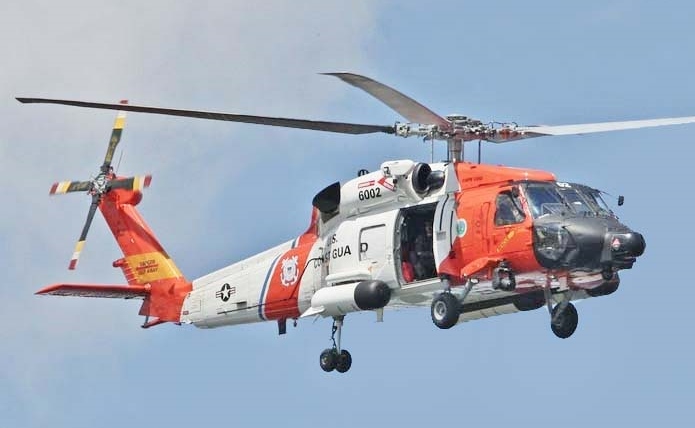
Before the Jayhawk ruled coastal skies, that duty belonged to an amphibious legend: the Sikorsky HH-3F Pelican. Entering service in the late 1960s, the twin-engine „Jolly Green Giant“ variant served as the Coast Guard’s primary medium-to-long-range search and rescue guardian for nearly three decades. Beloved for its roomy cabin and boat hull, it could land directly on the water in calm seas. But as the 1980s arrived, airframe fatigue, outdated analog avionics, and mounting maintenance burdens meant the Coast Guard needed a modernized successor. In September 1986, the Coast Guard initiated a contract with Sikorsky to build a dedicated Medium Range Recovery (MRR) aircraft. Rather than engineering an airframe from scratch, engineers turned to a battle-tested foundation: the Sikorsky S-70 family—specifically drawing from the U.S. Navy’s SH-60 Seahawk. The transition moved swiftly:
- August 8, 1989: The prototype Jayhawk achieved its maiden flight.
- June 1990: The initial production model—designated the HH-60J—officially entered USCG service.
- 1994: The final HH-3F Pelican was retired, marking the dawn of the Jayhawk era.
By 1996, the initial production run wrapped with 42 brand-new HH-60J helicopters delivered to Coast Guard air stations across the country. Yet the Jayhawk’s story did not end when factory lines closed. As operational demands surged after 2000, the fleet needed both numbers and modernized capabilities. Beginning in 2010, the Coast Guard expanded and rejuvenated the fleet through an ambitious conversion program at the Aviation Logistics Center (ALC) in Elizabeth City, North Carolina—remanufacturing retired U.S. Navy SH-60F Seahawks and bringing them up to the cutting-edge MH-60T standard flying today.
HH-60J Specs & Capabilities
While its sibling, the Army’s Black Hawk, was engineered to insert infantry under fire, the Coast Guard’s HH-60J Jayhawk was built to conquer a completely different adversary: vast distances, brutal ocean weather, and the relentless friction of time.
Built for the „300/45“ Mission Profile
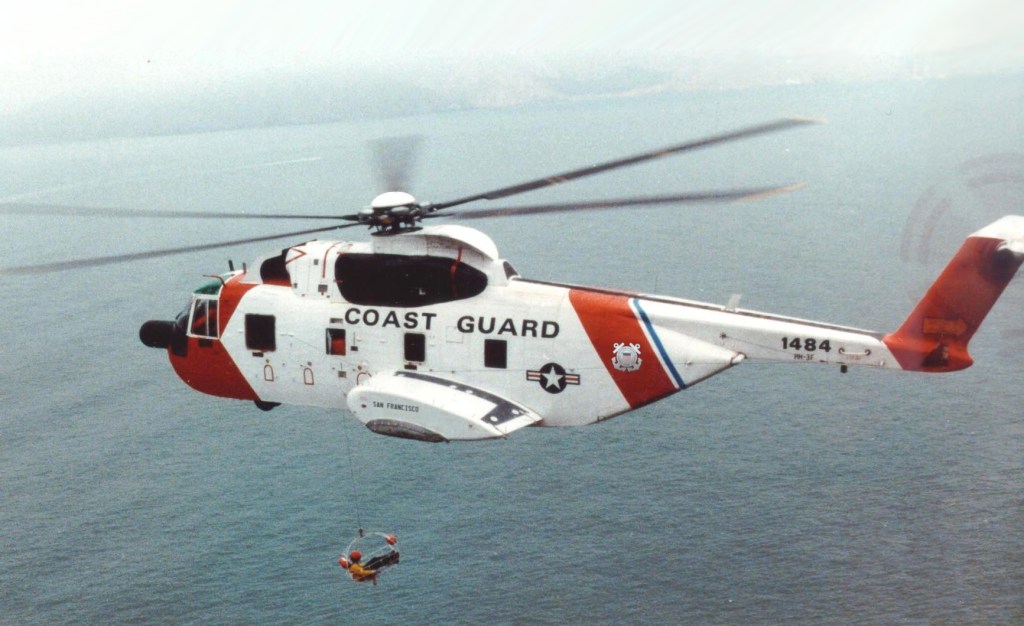
The defining operational requirement of the Jayhawk was the Medium Range Recovery (MRR) mission profile. The Coast Guard needed a platform capable of launching from shore, flying 300 nautical miles offshore, maintaining a stationary hover on scene for 45 minutes to hoist up to six survivors, and returning to base with adequate reserve fuel still in the tanks. To achieve this staggering endurance, the Jayhawk incorporates several specialized airframe adaptations:
- External Fuel Sponsons: Bulging cheek tanks and drop-tank provisions carry the fuel loads necessary for seven-hour search patterns over open water.
- All-Weather Search Radar: The bulbous nose radome houses specialized weather and search radar, critical for tracking small vessel targets across wave-churned waters and penetrating heavy squalls.
- Full Rotor & Engine De-icing: Crucial for northern postings like Alaska and Cape Cod, electric de-ice blankets on the main and tail rotor blades allow the aircraft to punch through freezing ocean mist that would ground lesser helicopters.
- The 600-Pound Lifeline: Mounted above the starboard sliding cabin door is a high-speed hydraulic rescue hoist with 250 feet of galvanized steel cable and a 600-pound payload capacity—capable of pulling multiple survivors and a litter out of surging swells in seconds.
| Metric | Capability |
| Max Gross Weight | ~21,880 lbs |
| Cruising Speed | ~140–150 knots |
| Mission Range | 300 NM radius (up to 700+ NM total ferry range) |
| Hover / On-Scene Time | 45+ minutes at maximum radius |
| Hoist Capacity | 600 lbs (250 ft cable) |
The Dynamic Four: Who Flies the Mission?
The machine is only half the equation; the Jayhawk’s real power lies in the tight coordination of its four-person crew, operating in an environment where cockpit chatter is stripped down to pure precision:
- Pilot in Command (Aircraft Commander): Manages the broader mission strategy, communicates with Coast Guard command centers, and maintains absolute spatial awareness over high seas.
- Co-Pilot: Handles navigation, radios, engine parameters, and shares the physically exhausting burden of flying instrument approaches down to low-altitude hover references over pitch-black water.
- Flight Mechanic (Hoist Operator): Positioned at the open cabin door strapped into a safety harness, the Flight Mechanic is the pilot’s „eyes below.“ Because the pilots cannot see directly underneath the aircraft, the Flight Mechanic talks the pilot through micro-adjustments on the controls while operating the hoist pendant with surgical accuracy.
- Aviation Survival Technician (AST / Rescue Swimmer): The tip of the spear. Clad in a dry suit, mask, and fins, the swimmer clips into the hook, leaps into frigid, 30-foot churning seas, calms terrified survivors, and secures them into the rescue basket.
When a 20,000-pound helicopter hovers 50 feet above crashing waves in gale-force winds, the safety of everyone on board rests entirely on the seamless synergy between these four roles.
The Post-9/11 Shift: Evolution from HH-60J to MH-60T
For its first decade, the Jayhawk was almost purely a rescue machine—denoted by the „HH“ prefix (Search and Rescue Helicopter). But the geopolitical shift following September 11, 2001, permanently expanded the Coast Guard’s mandate. Shifted under the newly formed Department of Homeland Security, the service needed its medium-range workhorse to handle maritime homeland security, counter-narcotics, and Airborne Use of Force (AUF). In 2002, the Coast Guard launched the Deepwater modernization initiative, upgrading the legacy fleet to the MH-60T (Multi-Mission Cutter Helicopter). By 2015, all active airframes had undergone this deep transformation:
- The Glass Cockpit (CAAS): Stripping out analog steam gauges, the Rockwell Collins Common Avionics Architecture System introduced five 6×8-inch full-color multi-function displays. Integrated flight management reduced pilot workload significantly during turbulent, low-altitude over-water hovers.
- Electro-Optical/Infrared (EO/IR) Sensor: Mounted in a chin turret, the FLIR thermal sensor gave crews the ability to spot a survivor’s heat signature among freezing swells miles away, or track darkened smuggler vessels running without navigation lights.
- Airborne Use of Force (AUF) Package: To interdict non-compliant vessels, the Jayhawk gained ballistic protection for crew seats and critical engine components, an M240H 7.62mm machine gun for warning shots, and a precision Barrett .50-caliber rifle used by marksmen to disable outboard boat engines directly from a hover.
The transformation turned a dedicated lifesaver into a dual-role asset: a flying ambulance one day, and an armed tactical enforcer the next.
Legend on the Water: Defining Operational Moments
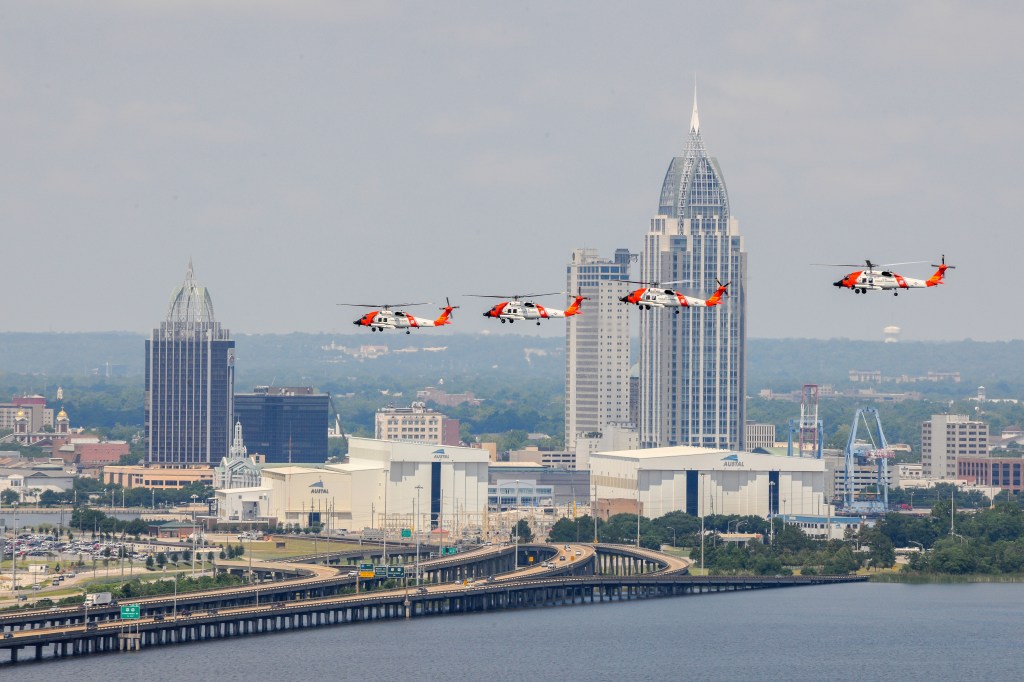
The Jayhawk’s reputation was earned in conditions where other aviation assets simply could not survive.
Hurricane Katrina (2005)
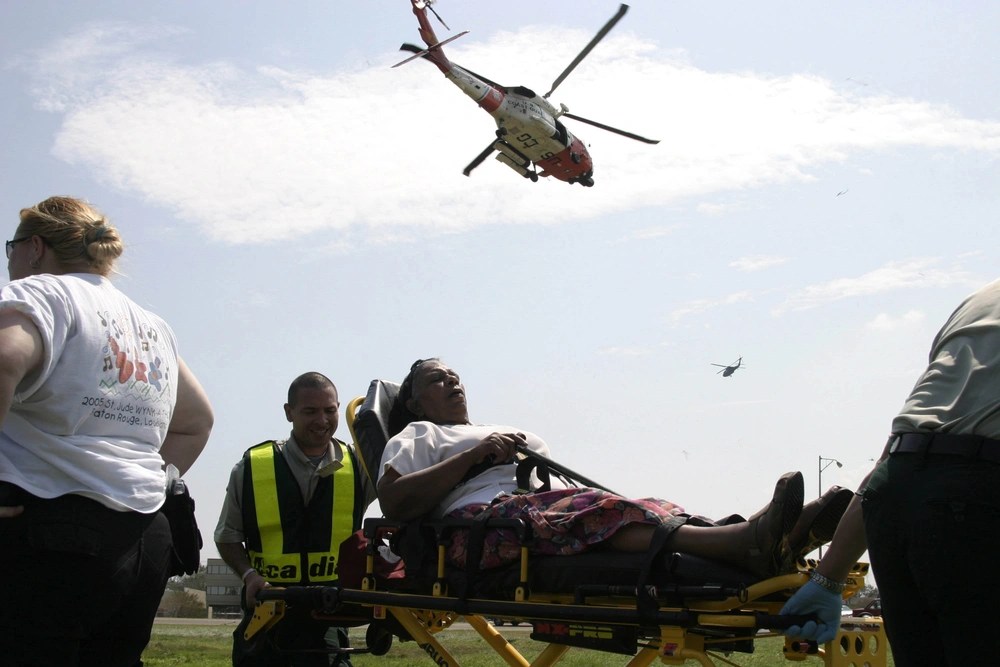
When Katrina submerged New Orleans and the Gulf Coast, Jayhawk crews flew round-the-clock sorties through squalls, tangled power lines, and toxic floodwaters. Hoisting families, pets, and the injured off rooftops and highway overpasses, Jayhawk and Dolphin aircrews collectively rescued over 33,500 people in one of the most successful search-and-rescue operations in modern history.
The Alaskan Graveyard
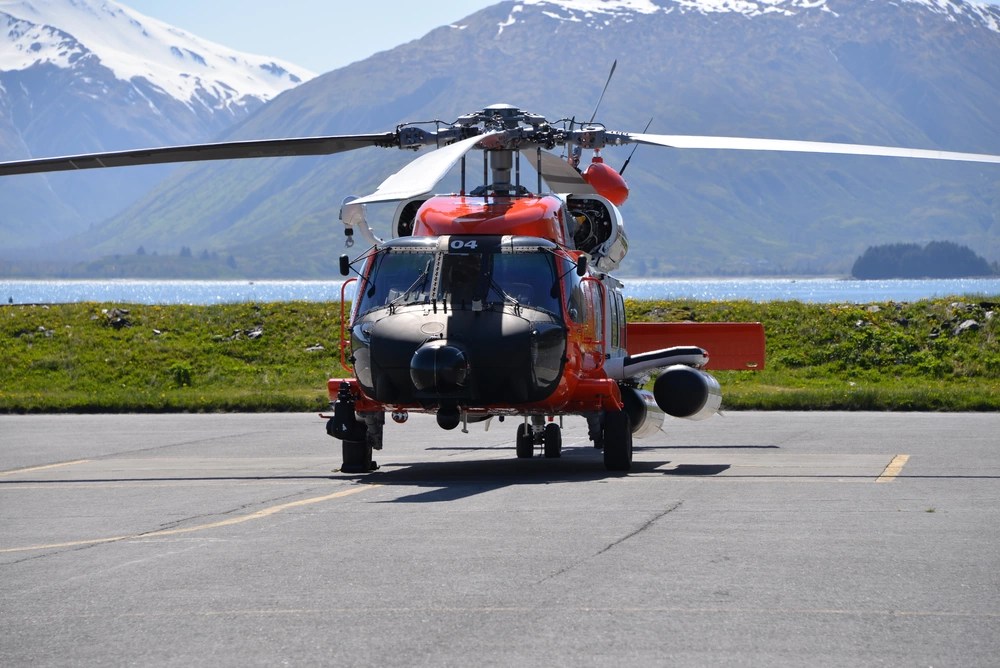
Nowhere is the MH-60T tested harder than with Air Stations Sitka and Kodiak in Alaska. Over the frigid waters of the Bering Sea and the Gulf of Alaska, crews regularly respond to commercial vessels taking on water in 35-foot freezing swells with sea spray accumulating as dangerous ice on the fuselage. The aircraft’s endurance allows it to bridge hundreds of miles of desolate sub-Arctic coastline where an engine failure or an unrecoverable hoist means certain catastrophe.
The Horizon: Service Life Extension & Future Replacement
How do you keep an airframe flying when components are decades old? The Coast Guard solved the problem through ingenuity at the Aviation Logistics Center (ALC) in Elizabeth City, North Carolina. Recognizing that the original fleet was exhausting its airframe hours, the Coast Guard engineered a comprehensive Service Life Extension Program (SLEP):
- Airframe Conversions: The Coast Guard acquired retired U.S. Navy SH-60F and HH-60H hulls, stripping them down to bare metal, removing naval equipment (such as dipping sonar and anti-submarine electronics), rewiring them, and installing brand-new factory MH-60T cockpits.
- New Hulls: In partnership with the Navy and Sikorsky, brand-new replacement cabin and hull structures were produced to reset fatigue life to zero hours, pushing fleet longevity out past the late 2030s.
- Transition to an All-60 Fleet: To streamline logistics and lower training overhead, the Coast Guard initiated plans to phase out the short-range MH-65 Dolphin, transitioning entirely to a standardized fleet of MH-60 Jayhawks for rotary-wing coverage across all air stations.
Looking toward mid-century, the Coast Guard continues to monitor the Department of Defense’s Future Vertical Lift (FVL) initiatives to identify its next-generation platform, but the Jayhawk remains irreplaceable for the foreseeable future.
The Guardian of the Coast
More than three decades after replacing the amphibious Pelican, the MH-60 Jayhawk has cemented itself as an undisputed icon of maritime aviation. It is an aircraft that was never intended to operate in ideal conditions; it exists precisely because things have gone disastrously wrong somewhere out at sea. From Alaskan blizzard rescues to the rooftops of flooded cities, the distinctive orange-and-white silhouette against a dark sky represents the absolute edge of human endurance and aeronautical engineering.For the mariner stranded in freezing waters or the crew of a sinking ship, the distant thumping cadence of twin T700 turboshafts through the gale brings one unmistakable realization: help has arrived, bound by a sacred promise—„So Others May Live.“
References
https://www.lockheedmartin.com/en-us/products/sikorsky-mh-60t-jayhawk-rescue-helicopter.html 08.10.2026
https://en.wikipedia.org/wiki/Sikorsky_MH-60_Jayhawk 08.10.2026
https://pimaair.org/museum-aircraft/sikorsky-hh-3f/ 08.10.2026


Hinterlasse einen Kommentar