
1. Introduction: The Unconventional Choice
In the 1970s, helicopters had already served as core operational assets of the United States Coast Guard for decades. Toward the end of that decade, however, the service faced a pressing procurement challenge: replacing the aging, amphibious Sikorsky HH-52A Seaguard. The Seaguard had been a legendary workhorse, responsible for over 15,000 saves, but its reciprocating heritage and speed limitations no longer matched modern coastal search and rescue doctrine. In 1979, the Coast Guard made a decision that sent shockwaves through the domestic aerospace establishment: it awarded a contract for 90 aircraft (later expanding to 102) to the French manufacturer Aérospatiale (later Airbus Helicopters) for their SA 366G Dauphin. Winning against established American designs like the Bell 222 and Sikorsky S-76, the sleek European twin-turbine aircraft promised unprecedented speed, composite durability, and shipboard agility. To comply with federal „Buy American“ mandates, the airframe could not simply be imported off the shelf. The helicopters were assembled on American soil in Grand Prairie, Texas, by the Aerospatiale Helicopter Corporation and fitted with American-built avionics and powerplants. Designated the HH-65A Dolphin, this imported thoroughbred brought cutting-edge European aerodynamics to the American coastline—though its political compromises would soon spark a decade-long engineering trial by fire.
2. Anatomy of the Dauphin: Built for Pitching Decks
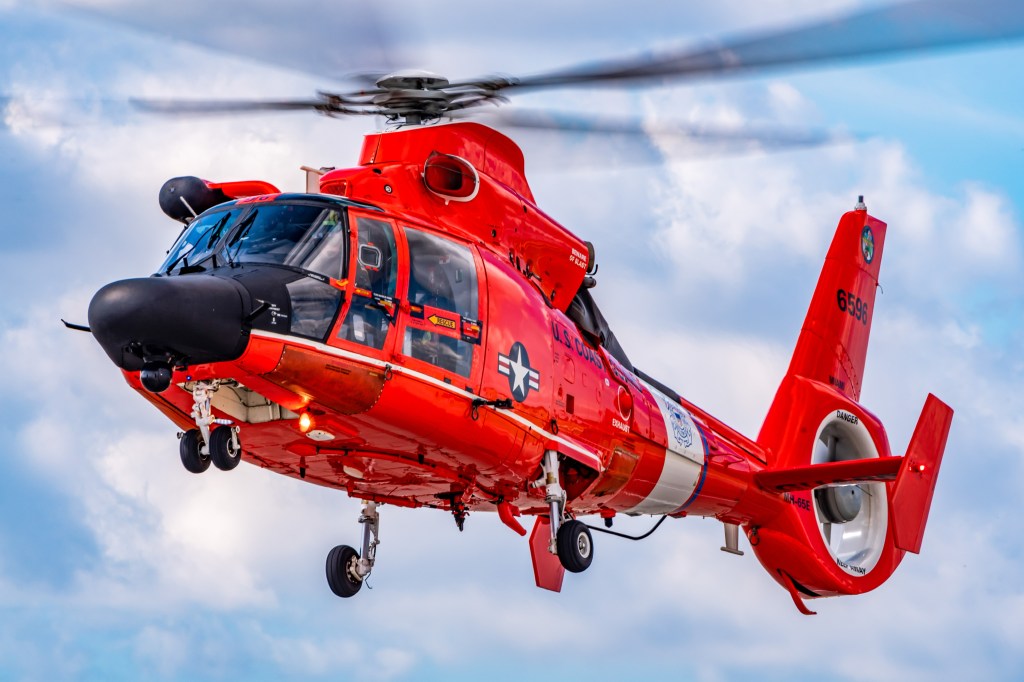
The Dolphin was engineered specifically for shipboard integration across cutters of varying tonnage—from 210-foot and 270-foot Medium Endurance Cutters (WMECs) to 378-foot High Endurance Cutters (WHECs)—often in severe maritime weather.
Two critical design features defined its shipboard success:
- The Fenestron Shrouded Tail Rotor: Unlike conventional exposed tail rotors that pose extreme hazard to deck crew, flight mechanics, and hoisted litters, the Dolphin’s anti-torque rotor was recessed into a circular duct at the base of the vertical stabilizer. This design housed 10 to 11 small composite blades within a protective shroud. Beyond eliminating the lethal hazard of spinning exposed blades on a crowded flight deck, the Fenestron shielded the rotor from damage caused by debris or rogue waves and provided remarkable yaw stability in high crosswinds.
- The Deck-Securing Interface (TALON): Operating off a pitching, rolling cutter required specialized deck-handling gear. The Dolphin was equipped with the TALON grid system—a hydraulically actuated, belly-mounted harpoon mechanism. Upon touching down on the cutter’s flight deck, the harpoon engaged a stainless-steel circular grid embedded in the deck surface, instantly locking the multi-ton aircraft securely in place before sea heave could slide it over the side.
Coupled with tricycle landing gear engineered to absorb heavy vertical impacts and a corrosion-resistant composite structure incorporating Nomex honeycomb and fiberglass, the Dolphin proved to be one of the most stable shipboard platforms in naval aviation history.
3. The Engine Crisis
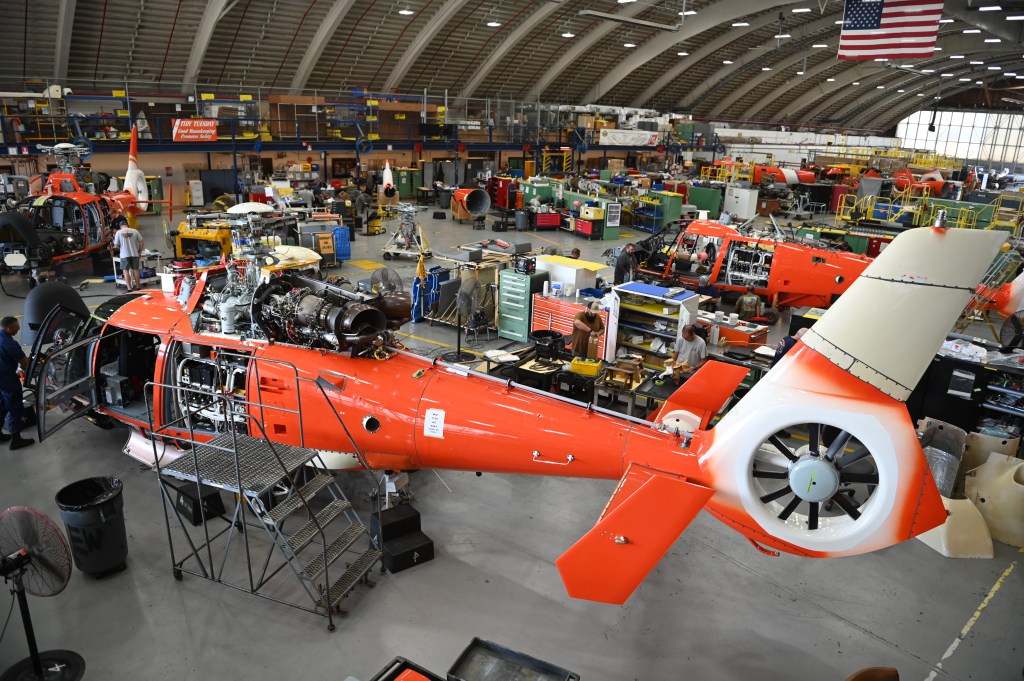
While the Dauphin airframe and its composite construction were aerodynamically forward-thinking, the politically mandated propulsion system nearly grounded the fleet before its career truly took off. To comply with federal „Buy American“ procurement requirements, the Coast Guard could not import the aircraft with its native French Turbomeca engines. Instead, the service selected the American-built Lycoming LTS101-750B-2 turboshaft. On paper, it met baseline performance requirements. In the brutal, real-world conditions of maritime search and rescue, however, it quickly revealed severe engineering shortcomings.
The primary issues stemmed from a critical combination of environmental stress and rapid weight gain:
- The Salinity and Thermal Burden: Operating at low altitudes in moisture- and salt-saturated air accelerated turbine blade erosion and thermal fatigue.
- The „Weight Creep“ Dilemma: As the Coast Guard integrated increasingly heavier avionics suites, thermal imaging cameras (FLIR), hoist equipment, and tactical radios into the cabin, the LTS101 engines were pushed past their operational tolerances.
- Loss of Power (LOP) In-Flight: The engines developed a notorious reputation for sudden, uncommanded power rollbacks and catastrophic in-flight shutdowns. For a crew holding a 40-foot hover over a pitching ship’s mast or lowering a rescue basket into a nocturnal surf zone, a sudden loss of single-engine flyaway capability was potentially fatal.
By the late 1990s, the engine reliability crisis reached a boiling point. The high failure rate forced the Coast Guard to impose strict operational constraints: fuel loads had to be restricted to save weight, flights had to avoid certain high-density altitude profiles, and pilots routinely practiced emergency autorotations and single-engine water landings. The breakthrough came under the Deepwater Modernization Program in the early 2000s. Recognizing that the airframe itself was still fundamentally sound, the Coast Guard initiated a critical re-engining effort. In 2004, the service contracted to install the engine the airframe was originally designed for: the Turbomeca Arriel 2C2-CG. The conversion to the HH-65C—completed across the fleet between 2004 and 2007—provided a massive 40 percent boost in total shaft horsepower. The new turbines delivered higher reliability, superior dual-channel digital engine control (FADEC), and the critical power margins needed to hover safely on one engine with a full load. This transformation was not merely an upgrade in flight safety; it unlocked the platform’s untapped potential, directly enabling the Coast Guard to transition the Dolphin from a pure lifesaver into a heavy, armed law enforcement asset.
4. From Lifesaver to Interceptor: The Birth of the Multi-Mission MH-65
With reliable power margins finally secured under the „Charlie“ upgrade, the Dolphin could carry significant new tactical payloads. Originally conceived in 1979 purely as a Short-Range Recovery (SRR) platform to pluck mariners from coastal waters, the airframe’s operational portfolio expanded rapidly into high-risk maritime law enforcement and national defense. The most dramatic transformation occurred under the banner of Airborne Use of Force (AUF). During the late 1990s, transnational drug cartels increasingly deployed custom „go-fast“ speedboats across the Caribbean and eastern Pacific. Powered by multiple high-horsepower outboard engines and running at speeds exceeding 40 to 50 knots, these vessels easily outran conventional Coast Guard cutters and small boats. To close this operational gap, the Coast Guard stood up the Helicopter Interdiction Tactical Squadron (HITRON) in Jacksonville, Florida. The service proved that the nimble, compact Dolphin—with its stable Fenestron tail and high agility—was the ideal platform to hunt speedboats from the air.
Re-designated as the MH-65 („M“ denoting Multi-Mission), the modified Dolphins received specialized tactical kits:
- Armed Interdiction Capability: Precision marksmen were stationed at the open cabin door, equipped with an M240G 7.62mm machine gun for warning shots across a smuggler’s bow and a Robar RC-50 or Barrett .50-caliber precision rifle. Using high-density anti-materiel ammunition, gunners targeted and disabled the vessel’s outboard engine blocks without harming the crew aboard.
- Electro-Optical / Infrared (FLIR) Sensors: Mounted beneath the nose, these high-resolution thermal imaging suites allowed crews to track blacked-out go-fast boats across vast stretches of dark ocean, feeding real-time tactical coordinates back to surface cutters.
- Cabin Armor & Ballistic Protection: Lightweight ceramic-composite armor was retrofitted around the cockpit and cabin floor to shield the aircrew from small-arms return fire during low-altitude pursuit runs.
Beyond counter-narcotics, the multi-mission Dolphin took on high-profile homeland defense duties following September 11, 2001. Operating as part of the Rotary Wing Air Intercept (RWAI) mission under the National Capital Region Air Defense Facility, MH-65 crews regularly patrolled the restricted airspace over Washington, D.C., intercepting unauthorized general aviation aircraft. Simultaneously, the airframe retained its maritime roots. Equipped with search and weather radars, Dolphins deployed aboard heavy and medium icebreakers (such as USCGC Polar Star and Healy), serving as long-range „eyes in the ice“ to scout navigable leads through pack ice. From an unarmed coastal rescue craft to a cutter-deployed tactical sniper platform, the Dolphin had fundamentally outgrown its original lifesaver designation.
5. The „Echo“ Upgrade & The Impending Sunset
By the late 2010s, the Dolphin had outlived almost all of its original contemporary competitors. Having conquered its early powerplant crises through the Turbomeca re-engining program and earned operational acclaim with HITRON, the airframe entered what would become its final and most sophisticated configuration: the MH-65E. Yet, beneath the polished orange-and-white composite exterior, the Coast Guard was confronting an inescapable reality familiar to all military aerospace historians—the law of diminishing mechanical returns.
The Glass Cockpit Revolution
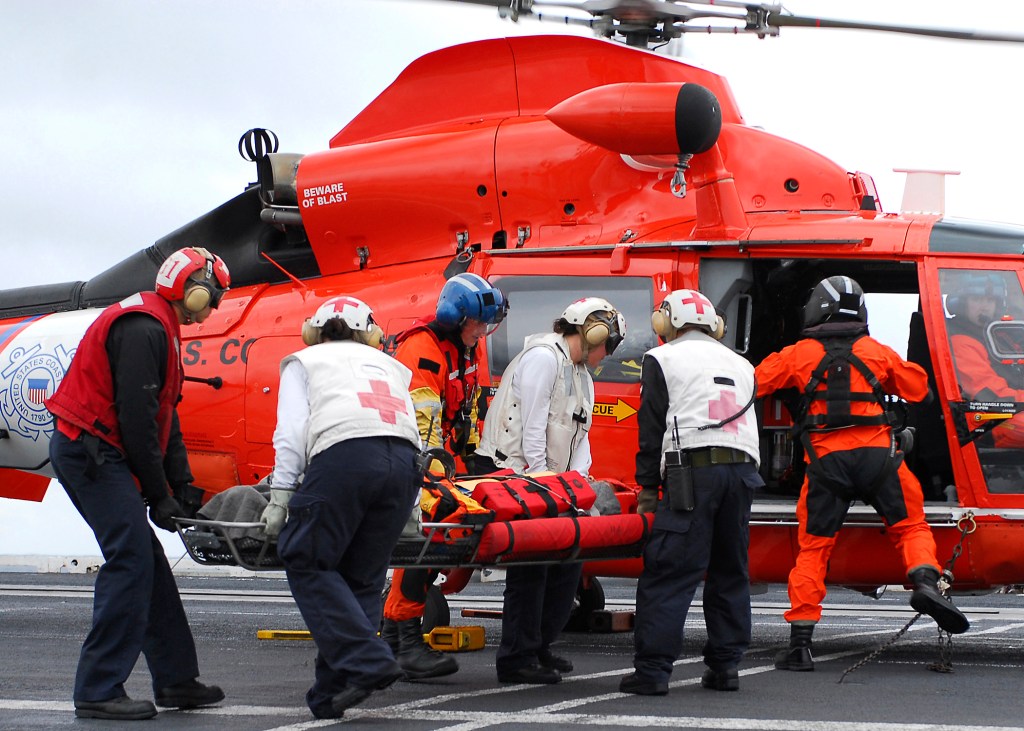
The MH-65E conversion—undertaken at the Aviation Logistics Center (ALC) in Elizabeth City, North Carolina—was designed to address widespread avionics obsolescence. Decades of piecemeal retrofits had turned the Dolphin’s cockpit into an ergonomic patchwork of analog steam gauges, legacy switches, and aftermarket displays. The „Echo“ upgrade replaced this heritage wiring with Collins Aerospace’s Common Avionics Architecture System (CAAS)—the same foundational digital software environment powering modern military rotorcraft. The upgrade introduced:
- Large-Format Digital Multi-Function Displays (MFDs): Consolidating flight instruments, digital engine monitoring, tactical moving maps, radar returns, and live electro-optical sensor video directly into the flight crew’s immediate scan.
- Digital 4-Axis Automatic Flight Control System (AFCS): Providing rock-solid automated hover coupling over water, allowing the aircraft to lock into a precise spatial coordinate even in pitch-black conditions or high-sea states.
- Integrated Flight Management Systems: Automating real-time weight-and-balance calculations, fuel-burn burn rates, and optimum search pattern tracks.
The MH-65E transformed the Dolphin into an extraordinarily responsive, low-workload instrument platform for nocturnal and adverse-weather hoist operations.
The Reality of Airframe Fatigue and the Transition to an All-Jayhawk Fleet
Despite the modern digital cockpit, the airframe could not outrun the physical realities of maritime operations. Decades of salt-spray corrosion, violent landings on rolling cutter flight decks, and structural fatigue on critical load-bearing composite bulkheads signaled that the airframe was approaching the end of its viable service life. Furthermore, as commercial Airbus production lines moved on to newer generations (such as the H160), sourcing bespoke replacement components for the legacy Dauphin airframe became increasingly cost-prohibitive. At the same time, the Coast Guard’s broader fleet architecture was evolving. With the construction of newer cutter classes—including the National Security Cutter (NSC) and Offshore Patrol Cutter (OPC)—cutter helodecks were designed from the keel up to support larger, heavier aircraft. As a result, the Coast Guard made the strategic decision to retire the MH-65 Dolphin fleet and consolidate its rotary inventory into a standardized, single-airframe fleet centered on the Sikorsky MH-60T Jayhawk. By converting low-hour Navy SH-60F/HH-60H hulls and executing a comprehensive Service Life Extension Program (SLEP), the service gained a uniform platform offering superior cabin volume, twin-hoist systems, and longer unrefueled oceanic endurance.
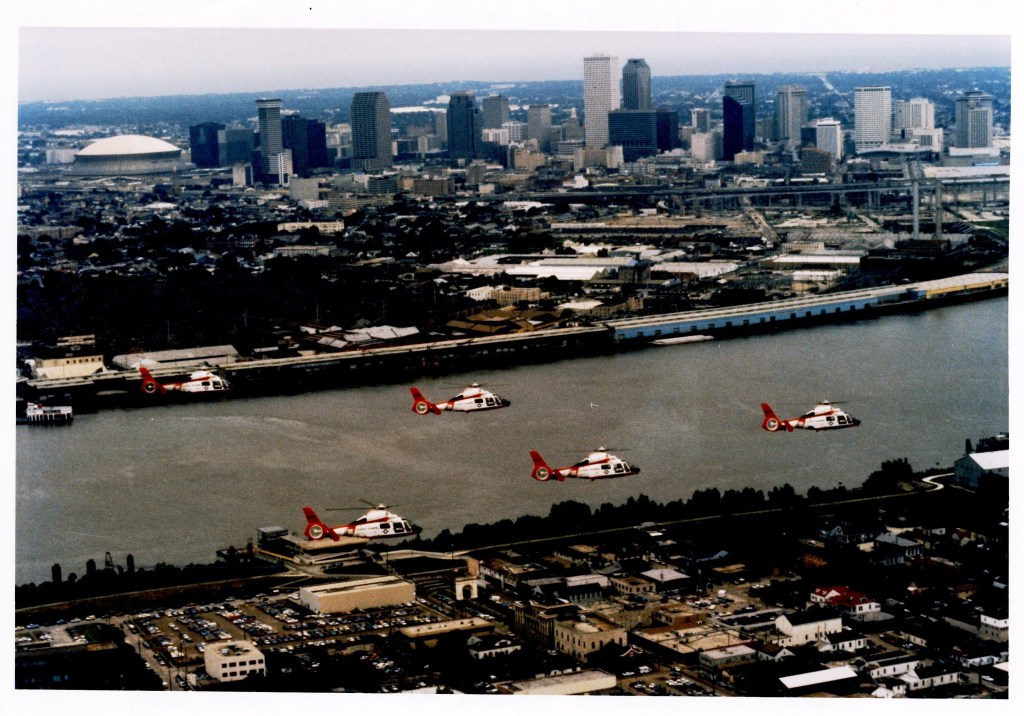
The Legacy of the French Lifesaver
As operational air stations gradually wind down their Dolphin operations, the aircraft leaves behind one of the most storied operational records in modern maritime aviation. What began in 1979 as a controversial foreign acquisition plagued by underpowered domestic engines evolved through sheer engineering tenacity into a legendary lifesaver and a lethal tactical interceptor. Over four decades of service, the MH-65 proved that European aerodynamic finesse and American maritime rescue doctrine could combine into a world-class guardian of the sea.
References
https://www.airbus.com/en/products-services/helicopters/military-helicopters/mh-65


Hinterlasse einen Kommentar