
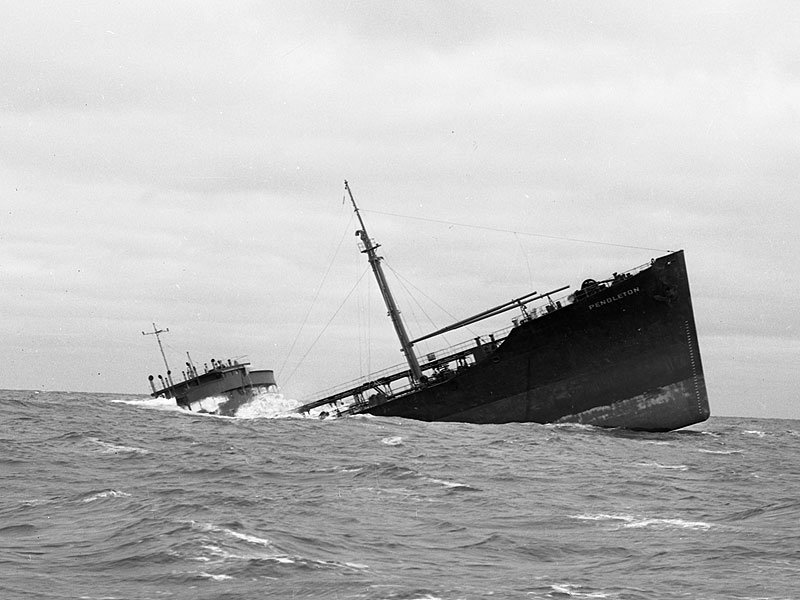
On February 18, 1952, the weather in Chatham, Massachusetts, was utterly brutal. A blinding blizzard was raging, whipping up 60- to 70-foot-high waves out at sea. Amid that maritime turmoil, two massive T2 tankers—the SS Pendleton and the SS Fort Mercer—snapped completely in half.
Over 70 sailors were trapped across the fractured ships, unable to evacuate the sinking remains. The SS Pendleton alone carried 33 crew members, who desperately needed rescue. Their lives ultimately depended on a tiny wooden lifeboat, the CG-36500, and the four brave Coast Guardsmen who went out despite all the odds stacked against them: Boatswain’s Mate First Class Bernard Webber, Engineman Third Class Andrew Fitzgerald, Seaman Richard Livesey, and Seaman Ervin Maske. What followed would come to be known as the greatest small-boat rescue in Coast Guard history.
The Setup: A Recipe for Disaster
The SS Pendleton was a Type T2-SE-A1 tanker built in 1942 in Portland, Oregon, for the War Shipping Administration. These wartime vessels were notoriously prone to splitting in two in cold waters due to „brittle fractures“ in their steel hulls. Sending them out into a freezing New England nor’easter was a true recipe for disaster. It was no coincidence that both the Pendleton and the Fort Mercer suffered the exact same catastrophic structural failure on the very same day.
The Vessel: Meet the 36-Foot Miracle
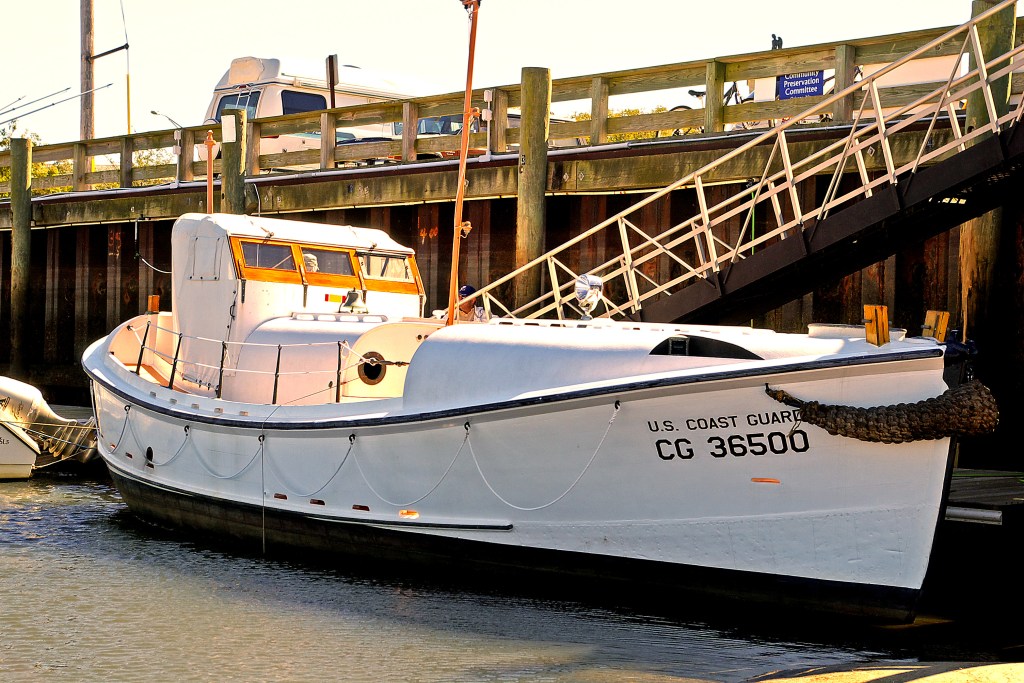
o understand the sheer madness of the rescue, you have to look at the boat Bernie Webber and his crew were sitting in. They weren’t aboard a modern, armored steel cutter. They were in the CG-36500, a standard 36-foot wooden motor lifeboat built in 1946 at the Coast Guard Yard in Curtis Bay, Maryland. On paper, a 36-foot wooden boat sounds like a toy to pit against a deadly Atlantic storm. But the CG-36500 was built like a tank disguised as a tugboat.
Built to Take a Beating
Weighing in at nearly 20,000 pounds, the boat was constructed with incredibly tough white oak frames and clad in thick cypress planking. To give it extra defense against the winter elements, it was sheathed with Monel plating: A highly corrosion-resistant nickel-copper alloy, which actually allowed the Coast Guard to use the little boat for light ice-breaking duties in local harbors.
But its real superpower lay in its physics:
- The Unflippable Keel: Bolted to the bottom of the hull was a massive, 2,000-pound bronze keel. This acted like a heavy pendulum. If a rogue wave flipped the CG-36500 upside down, the weight of the keel would instantly force the boat to right itself.
- Self-Bailing Decks: Built with watertight compartments and a self-bailing design, the boat could handle the open ocean. If a massive wave washed over the deck and filled the cockpit with tons of water, the sea would immediately drain out of side scuppers within seconds before the boat could swamp or sink.
| Length | 36 feet (11 meters) |
| Hull Material | White Oak frames with Cypress planking, sheathed with Monel plating |
| Total Weight | 20,000 pounds (9,100 kg) |
| Ballast | 2,000 lb bronze keel |
| Engine (1952) | Sterling Petrel 6-cylinder gasoline |
| Safe Capacity | 12 passengers (plus 4 crew) |
The Engine Room Gamble
During its later life as a museum boat, the CG-36500 was fitted with a reliable 95-horsepower Detroit Diesel engine. But on that freezing night in 1952, it was powered by a temperamental, 6-cylinder Sterling Petrel gasoline engine. Because it was carbureted, it struggled heavily in cold, soaking wet conditions. Every time a monstrous wave tossed the boat into the air or rolled it violently on its side, the engine would choke and stall. Engineman Andrew Fitzgerald spent the night trapped in the tiny, fumes-filled engine compartment, repeatedly restarting the sputtering motor while being tossed around like a ragdoll. If that engine died permanently in the middle of the breakers, the crew faced certain death.
The Impossible Math: 12 Seats for 32 Men
The most crucial design detail to understand was its capacity. The boat was engineered to safely carry 12 passengers in addition to its 4-man crew. When Bernie Webber finally located the fractured stern of the SS Pendleton out in the pitch black, he didn’t find 12 men waiting. He found 33. To save them all, Webber would have to throw the boat’s capacity rules completely out the window, ultimately cramming 36 men onto a 36-foot boat—shattering its safety margins and riding so low in the water that the gunwales were practically level with the raging sea.
Crossing the Chatham Bar
Before they could even hope to reach the SS Pendleton, the crew had to conquer the infamous Chatham Bar—a shallow, shifting sandbar where the ocean breaks violently into the harbor. As they hit the bar’s massive 30-foot breaking waves, a wall of water threw the boat high into the air. The impact shattered the vessel’s glass windshield, blinding Bernie Webber with flying shards, and ripped the ship’s compass clean off its mounting. Left with no navigational instruments, they were forced to steer completely by instinct and engine sound in the pitch darkness, pushing forward into the freezing gale until they finally located the dying tanker.
The Rescue: 36 Men, 12 Seats
It must have been a grim, awe-inspiring sight to see the towering, twisted steel stern of the SS Pendleton looming out of the dark, illuminated only by the small, ice-crusted searchlight of the 36500. The tanker’s remaining crew tossed a makeshift Jacob’s ladder over the side. One by one, frozen men timed their leaps perfectly, freezing as they fell into the pitching lifeboat or directly into the icy waters to be yanked aboard by the crew. While the 36500 was built for 12 passengers, Webber refused to leave a single soul behind. Tragically, one crewman, George „Tiny“ Myers, was lost when he was crushed between the two vessels during the chaotic evacuation, but the remaining 32 survivors were successfully packed onto the tiny lifeboat.
Aftermath and Legacy
With 36 men now crowding the deck and cabin, the CG-36500 miraculously navigated its way back through the treacherous waters without a compass. They were greeted by a massive, stunned crowd at the Chatham fish pier, where locals helped the frozen survivors ashore. For their unmatched courage and seamanship, Boatswain’s Mate First Class Webber, Engineman Third Class Fitzgerald, Seaman Livesey, and Seaman Maske all received the Gold Lifesaving Medal, the Coast Guard’s highest decoration for heroism during a rescue operation.
Today, the meticulously restored CG-36500 is maintained by the Orleans Historical Society, serving as a floating museum and a permanent monument to the night that four men in a wooden boat achieved the impossible.
References
https://coastguardfoundation.org/news/the-finest-hours-story-behind-the-coast-guards-greatest-small-boat-rescue (17.07.2026).
https://en.wikipedia.org/wiki/SS_Pendleton (17.07.2026).
https://en.wikipedia.org/wiki/Coast_Guard_Motor_Lifeboat_CG_36500 (17.07.2026).


Hinterlasse einen Kommentar