
Introduction
„Why were there no buoys in life to show you the way? — Nora Roberts
The desire for a clear path is as old as humanity itself. That is perhaps nowhere more true than for travels at sea, where finding the right way—especially close to the shore or in hazardous areas—can mean the difference between life and death.
Aids to navigation have existed since antiquity, from grand lighthouses like the Pharos of ancient Alexandria to much smaller floating buoys. The first recorded buoy was mentioned in La Compasso de Navigare (1295). Located in the Guadalquivir River, this early aid guided mariners safely approaching Sevilla, Spain.
In this article, we are going to dive deep into the history of buoys and tenders, focusing on the remarkable lineage of the United States Coast Guard. Join me on a journey through the evolution of these true „Guardians of the Sea Roads!“
The Chaos of the Early System
The earliest recorded buoys in North American waters were the cask buoys placed in the Delaware River (1767) and the spar buoys deployed in Boston Harbor (1780). While many other regional markers existed, an absence of central record-keeping made updating maps or executing routine buoy maintenance nearly impossible. In short, the early system was chaotic.
As the new republic grew, the vital reliance on waterways for structural supplies, military troop movements, and commercial shipping pushed the federal government to standardize its maritime infrastructure. On August 7, 1789, the First Congress passed An Act for the Establishment and Support of Light-Houses, Beacons, Buoys, and Public Piers. This landmark legislation brought aids to navigation under federal regulation and placed their upkeep under the Department of the Treasury. Until 1801, when Congress began funding the service through direct annual appropriations, maintenance was funded entirely by „light fees“ collected from merchant vessels entering U.S. ports.
Lateral vs. Cardinal Systems
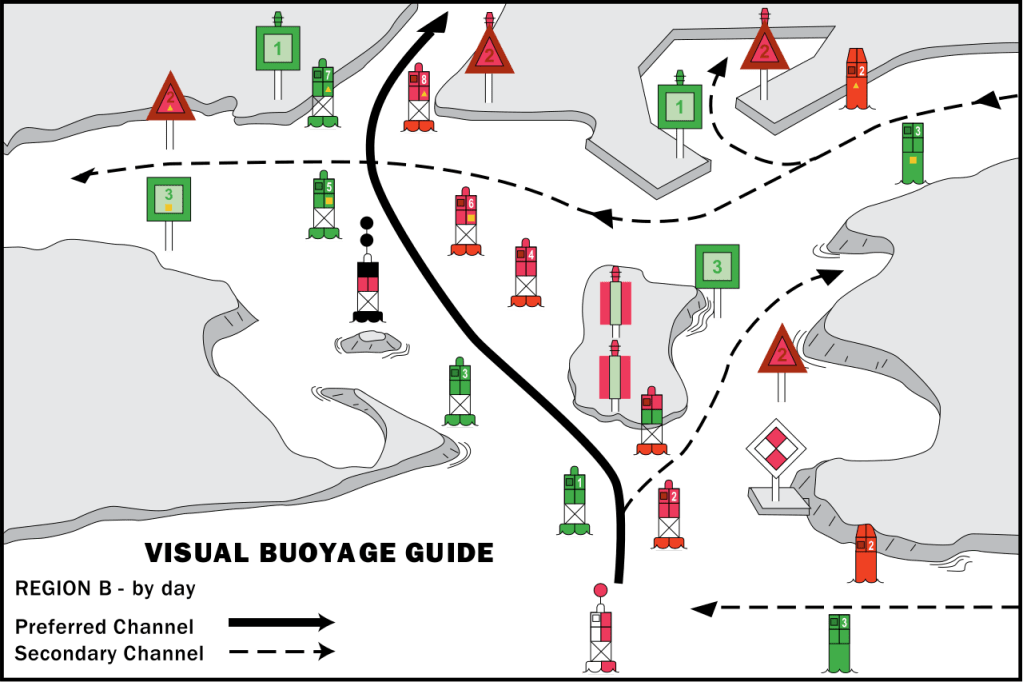
Up until the 1840s, the design and placement of buoys remained decentralized, left entirely to local custom house collectors and private contractors whose regulations were loose at best. To establish a uniform standard, Congress adopted the Lateral System for nationwide implementation.
The Lateral System defines boundaries by designating sides of a channel relative to a vessel’s direction. Instead of marking specific compass-based hazards (the hallmark of the Cardinal System), the lateral framework relies on a predictable standard: the positioning is fixed from the perspective of a ship returning from the open sea toward a harbor or traveling upstream. Implementing this system nationwide reduced critical piloting errors, standardized coastal charts, and saved countless lives.
The Scientific Revolution & The Rise of Steam
To place and relieve these growing buoy networks in open water, specialized vessels known as buoy tenders were required. Prior to the industrial revolution, these tasks were handled by small, slow wooden sailing craft or rowing boats with highly limited lifting capacities. However, the mid-19th-century transition to faster, deep-draft commercial steamships mandated a technological leap. Larger vessels required significantly larger, more visible buoys equipped with automated light and sound mechanisms so lookouts could spot them from a safe distance.
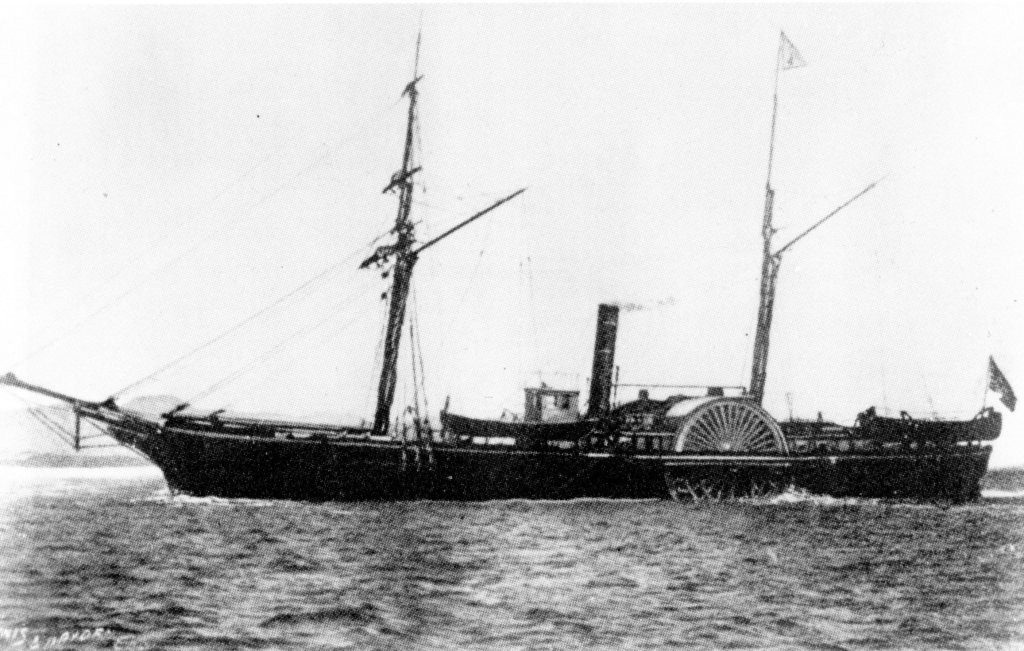
To handle these heavier loads, tenders needed to serve as stable, durable work platforms capable of holding a precise position near rocky shoals or shallow channels. This structural demand led naval architects to abandon wood in favor of iron, and eventually, welded steel plates. The integration of steam propulsion provided these hulls with unprecedented power to combat rough seas. The turning point arrived with the USLHS Shubrick in 1857—the first steam-propelled tender built from the keel up for the service. Featuring straight sides and a flat-bottomed design, the Shubrick proved that steam-powered crews could safely lift, service, and precisely drop massive buoys on triangulated chart stations.
Integration into the Coast Guard & The 133-Foot Fleet
The year 1939 marked a massive structural consolidation in American maritime history when the U.S. Lighthouse Service was officially dissolved and integrated into the U.S. Coast Guard. With this historic merger, traditional lighthouse tenders were reclassified as Coast Guard Cutters, and „buoy tender“ became an official military hull designation. This transition expanded the crew’s mission from pure logistical supply to a multi-faceted portfolio encompassing search and rescue (SAR), icebreaking capabilities, and maritime law enforcement.
Following the strains of World War II, the Coast Guard faced a severely depleted fleet and a lack of immediate federal appropriations to construct new vessels from scratch. To solve this bottleneck, the service creatively adapted a massive wartime asset: the U.S. Navy’s surplus YF-257 class self-propelled covered lighters. Built originally in 1942–1943 to shuttle military freight and ammunition across busy naval ports, these all-steel vessels possessed ideal structural characteristics for coastal buoy work:
- Stable Hull Dynamics: Measuring 132 feet, 6 inches in length with a broad 30-foot beam and a flat bottom, these hulls provided an exceptionally stable, low-profile working deck for hazardous, heavy-lifting operations.
- The „White“ Class: Upon entering Coast Guard service, these converted naval lighters were designated as WAGL (later WLM, or Medium Coastal Buoy Tenders). In a lasting stylistic tradition, they were named after plants, trees, or shrubs with a „White“ prefix, including the White Sumac, White Holly, White Sage, and White Pine.
| Innovation / System | Technical Execution & Operational Impact |
| Heavy-Duty A-Frames | The original single-mast and boom derrick setups were stripped and replaced with heavy-duty, hydraulically powered A-frame masts capable of lifting up to 20,000 pounds. |
| River Pushers & Spuds | Select units (such as White Pine) were fitted with bow pusher structures and retractable vertical stanchions called „spuds“. Dropping these heavy poles into the mud bottom anchored the ship firmly in place against swift river currents where standard anchors couldn’t catch. |
| The Solar Revolution | Beginning in the 1950s, the Coast Guard systematically phased out highly volatile, hazardous acetylene gas buoys in favor of long-lasting 12-volt battery packs. By the 1980s, the service pioneered floating solar arrays, mounting upward-facing photovoltaic panels on the buoy structures to recharge batteries by day. This shift saved millions of dollars in logistical maintenance and reduced crew exposure to explosive gases. |
| The Precision of DGPS | For generations, fixing a buoy’s location required precise math and manual sextants. The introduction of Differential Global Positioning Systems (DGPS) in the 1990s revolutionized the deck, cutting positioning stress in half and allowing conning officers to routinely drop a multi-ton concrete sinker within a single meter of its chart coordinate. |
By the early 2000s, after more than half a century of grueling, unheralded work keeping the nation’s commercial channels clear, the final converted 133-foot lighters were systematically decommissioned. They passed their legacy on to the state-of-the-art, 175-foot Keeper class—modern coastal tenders equipped with independent 360-degree rotating Z-drive propulsion units that carry the exact same vital mission into a new century of seafaring.
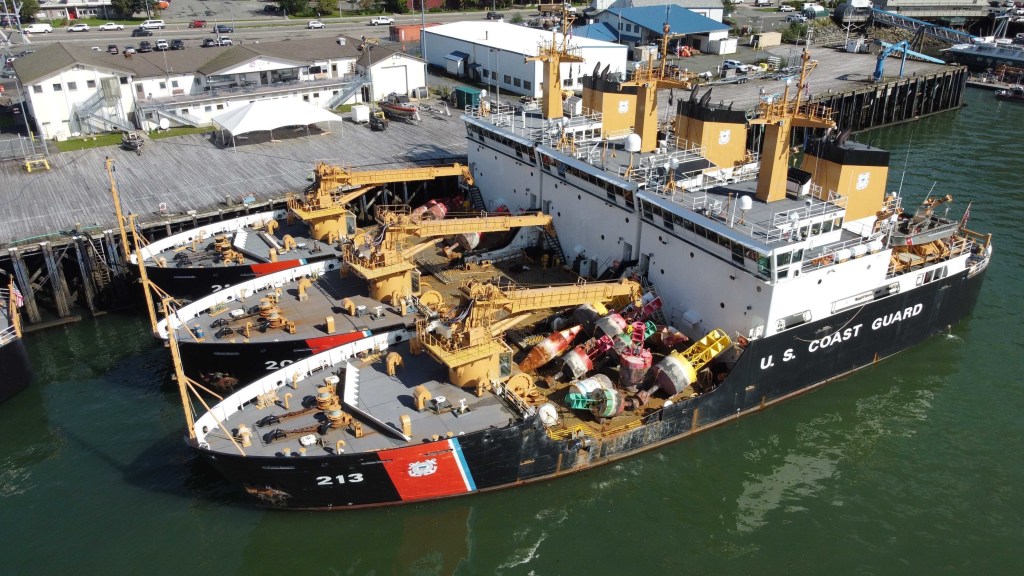
Buoy Tender Round-up is a week-long event that gives participants an opportunity to receive specialized training, provide discussions to enhance operations, and hold a Buoy Tender Roundup Olympics to test their seamanship skills. -U.S. Coast Guard photo by Lt. Cmdr. Scott McCann
Conclusion: The Living Legacy of Safe Sea Roads
The journey of America’s aids to navigation is a striking testament to technological and administrative resilience. What began in the late 18th century as a fragmented, primitive system of hollow wooden casks, cedar spars, and localized port tolls has evolved into a highly coordinated network of satellite-guided, solar-powered steel giants. By aggressively embracing breakthroughs in material science, automated fuel systems, and satellite positioning, the United States successfully transformed itself from an early maritime navigational backwater into a definitive global leader in sea safety.
This evolution illustrates a profound continuity of mission. Across more than 150 years of shifting administrative bodies—moving from the early Treasury bureaucrats to the scientific focus of the quasi-military Light House Board, through the sweeping structural overhauls of the Bureau of Lighthouses, and finally into the modern U.S. Coast Guard—the core objective has never wavered. While the wooden hulls and auxiliary sails of early tenders have long since yielded to specialized steel plating and advanced Z-drive propulsion, the underlying operational reality remains unchanged. Tending the nation’s buoys still requires a rare combination of precise engineering and physical endurance. Ultimately, it is the raw dedication of the crews working on the rolling decks of these tenders that keeps the world’s busiest sea roads reliably open and safe for mariners everywhere.
References
Clifford, Candace and Foster, Kevin: U.S. Coast Guard 133-Foot Buoy Tenders. National Park Service, U.S. Department of the Interior / U.S. Coast Guard Headquarters, 2004.
Marshall, Amy K.: „A History of Buoys and Tenders.“ The Commandant’s Bulletin. U.S. Coast Guard Headquarters, Washington, D.C., 1995.
Marshall, Amy K.: Frequently Close to the Point of Peril: A History of Buoys and Tenders in U.S. Coastal Waters 1789–1939. Master’s Thesis, East Carolina University, Department of History, 1997.


Kommentar verfassen