
In an era dominated by satellite navigation, autonomous vessels, and digital bridge simulators, the sight of a multi-masted tall ship cutting through the ocean might seem like a romantic anachronism. Yet, for two of the world’s premier maritime organizations—the United States Coast Guard and the German Deutsche Marine—these wind-driven vessels remain the absolute gold standard for foundational officer training.
Even more fascinating than their ongoing relevance is their deeply intertwined history. The USCGC Eagle (WIX-327) and the German Navy’s Gorch Fock (II) are not merely operational equivalents; they are literal design sisters, sharing a common lineage forged in the same shipyard.
A Shared DNA: The Blohm & Voss Legacy
To understand the connection between the „Barque of the Border“ and the pride of the German Navy, one must look back to the German city of Hamburg in the 1930s.
Following the tragic loss of the training ship Niobe in 1932, the German Reichsmarine commissioned the renowned shipyard Blohm & Voss to design a new, ultra-stable class of sail training ships. The result was the Gorch Fock class (Type 411)—mighty three-masted barques engineered with high righting moments to withstand severe weather.
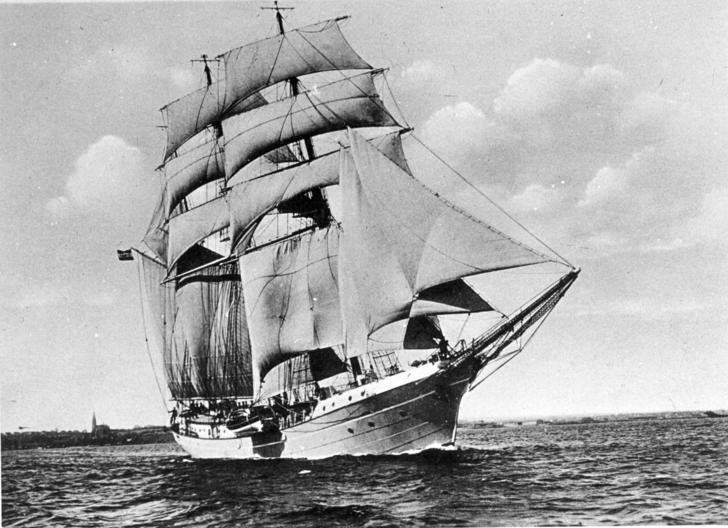
The Original Gorch Fock (1933): The lead ship of the class, named after the maritime writer Johann Kinau (pen name Gorch Fock).
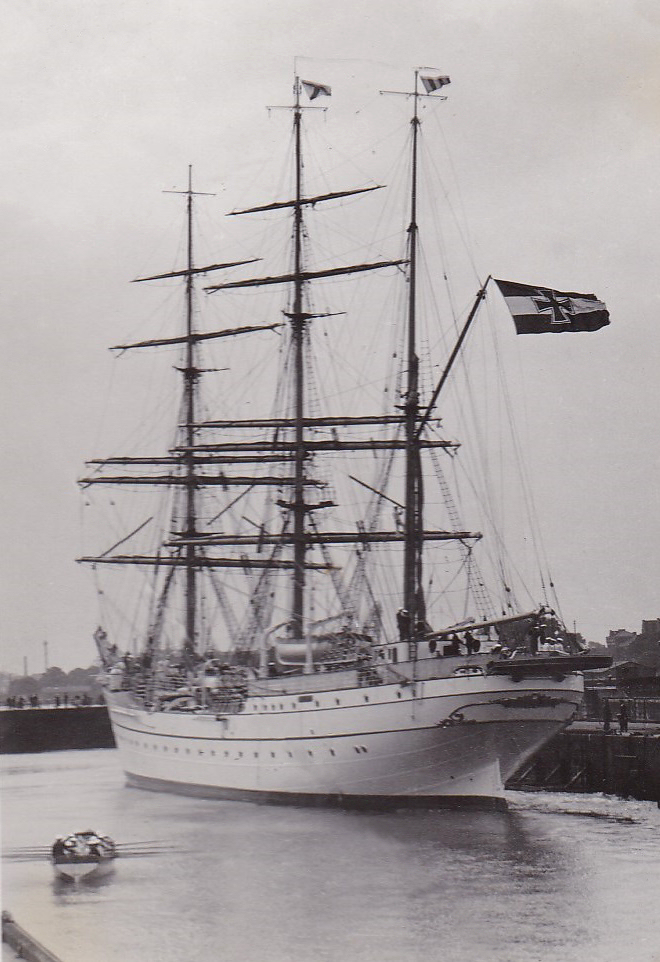
The Horst Wessel (1936): The second ship of the class, featuring a slightly elongated hull and a fully steel structure. This vessel would later become the USCGC Eagle.
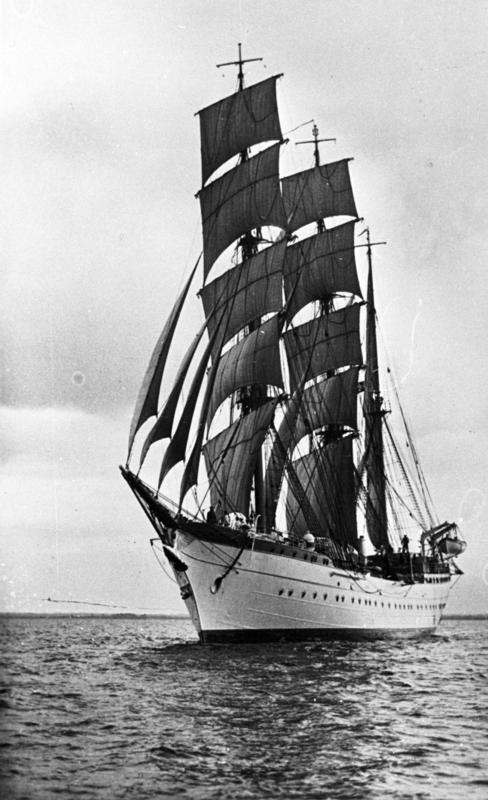
The Post-War Split: Following World War II, the surviving ships of the class were distributed as war reparations. The Horst Wessel was claimed by the United States, commissioned into the U.S. Coast Guard in 1946, and sailed across the Atlantic to her new home in New London, Connecticut. From this year on, she sails as the USCGC Eagle for three months each year for the United State Coast Guard.
Interesting fact: The figurehead of the Horst Wessel was an eagle with an opened beak. The USCG changed it to an eagle with a closed beak, the version that also appears in the sigil of the USCG. The old figurehead can still be seen in the U.S. Coast Guard Museum in New London.
A new Gorch Fock
When West Germany sought to rebuild its naval training fleet in the 1950s, they didn’t reinvent the wheel. They returned to the proven Blohm & Voss blueprints. In 1958, the modern Gorch Fock II was launched. While technically a new vessel incorporating upgraded safety standards (especially following the Pamir disaster of 1957), she was built to the exact fundamental design of her pre-war sister ships.
Technical Specifications: Side-by-Side
Despite decades of independent refit schedules, structural overhauls, and modernization efforts on opposite sides of the Atlantic, the physical profiles of the Eagle and the Gorch Fock II remain strikingly similar.
| Feature | USCGC Eagle (WIX-327) | Gorch Fock II (1958) |
| Rigging Type | Three-masted Barque | Three-masted Barque |
| Length Overall (LOA) | 90 m (295 feet) | 89.3 m (293 feet) |
| Beam (Width) | 11.9 m (39.1 feet) | 12 m (39.4 feet) |
| Draft | 4.9 m (16 feet) | 5.35 m (17.5 feet) |
| Displacement | ~1,824 metric tons | ~2,010 metric tons |
| Max Sail Area | 2,074 m² (22,300 sq ft) | 2,037 m² (21,926 sq ft) |
| Hull Material | Riveted & welded steel | Welded steel |
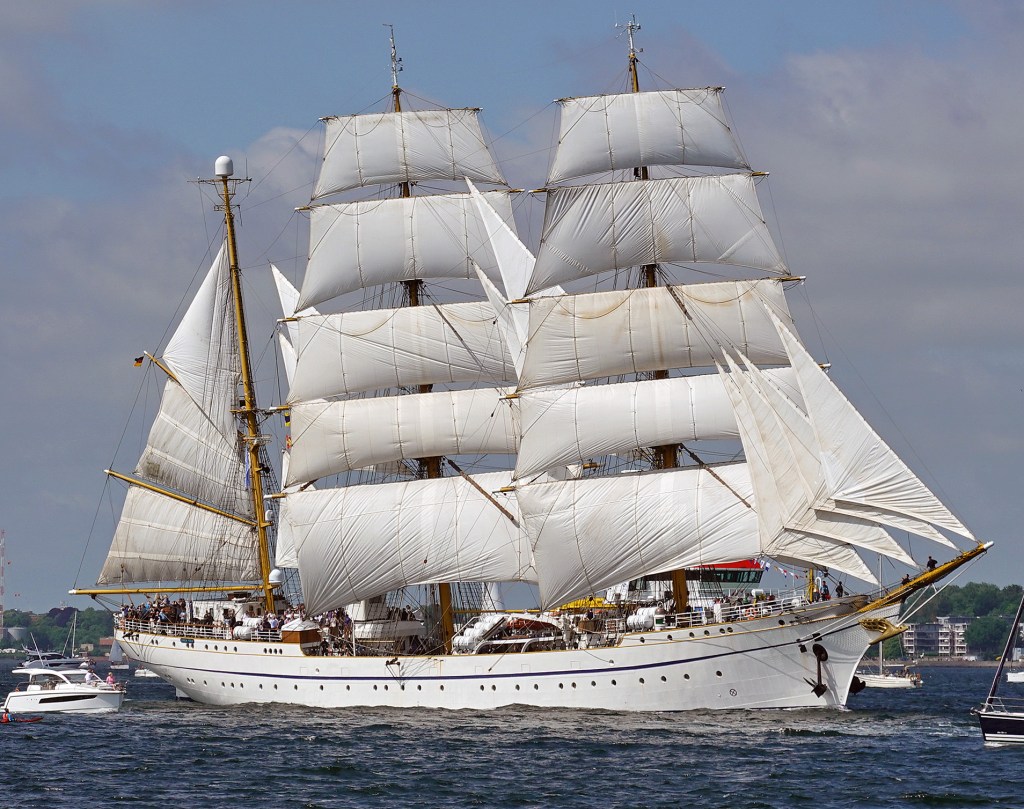
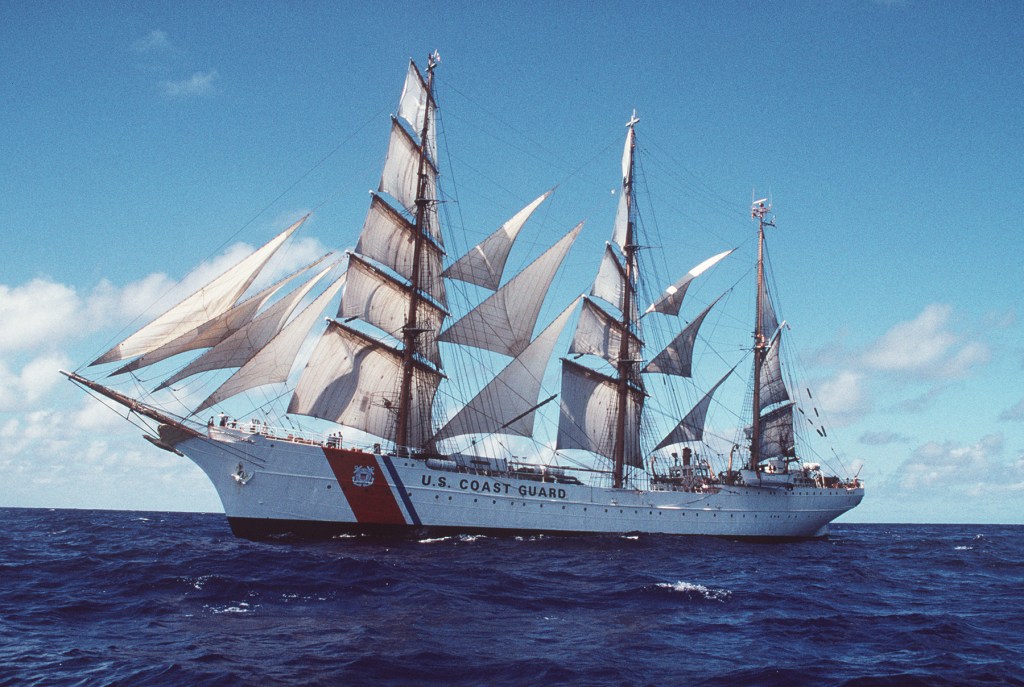
Note on Rigging: Both vessels are rigged as barques, meaning the foremast and mainmast are square-rigged (optimized for sailing downwind), while the mizzenmast (the aft-most mast) is fore-and-aft rigged, allowing for better performance when sailing closer to the wind.
The Pedagogical Science: Why Sail Training Matters in 2026 (and probably always will)
Critics occasionally question the fiscal and operational logic of maintaining capital-intensive sailing ships for modern military forces. However, the pedagogical „scaffolding“ provided by sail training cannot be replicated in a classroom or on a modern diesel-driven cutter.
Environmental Literacy and Instinct
On a modern vessel, a watch officer monitors weather patterns via radar overlay and satellite feeds. On the Eagle or Gorch Fock, trainees feel the barometric shift in their bones. They must read the surface of the water, anticipate wind shifts, and understand how the forces of nature directly impact a multi-thousand-ton steel hull. This builds an intuitive seamanship that technology can supplement, but never replace.
Radical Interdependence
The sails of these barques cannot be hoisted or furled by turning a key or pushing a button. It requires synchronized, manual muscle power. If a squall hits in the middle of the night, dozens of trainees must work in absolute unison, high above the deck on the yards, trusting their shipmates to hold the lines below. This environment strips away ego and forces the development of immediate, high-trust teamwork—the exact tribal cohesion required during high-stakes search and rescue (SAR) or tactical naval maneuvers.
Leadership Under Duress
Climbing a 45-meter mast in heavy seas forces a young officer candidate to confront fear, manage stress, and communicate clearly under exhaustion. It is a controlled crucible. A cadet who can confidently command a division to handle a sail in a gale will carry that psychological resilience to the bridge of a modern national security cutter or a naval frigate.
Floating Diplomatic Academies
Beyond their educational mandates, both vessels serve critical geopolitical functions as the ultimate soft-power assets for their respective nations. When the Eagle or the Gorch Fock drops anchor in a foreign port, they become spectacular backdrops for international diplomacy. They host ambassadors, military leadership, and the public, projecting goodwill and maritime heritage in a way that an armed grey hull simply cannot. They are, quite literally, sailing ambassadors.
Conclusion: An Enduring Legacy
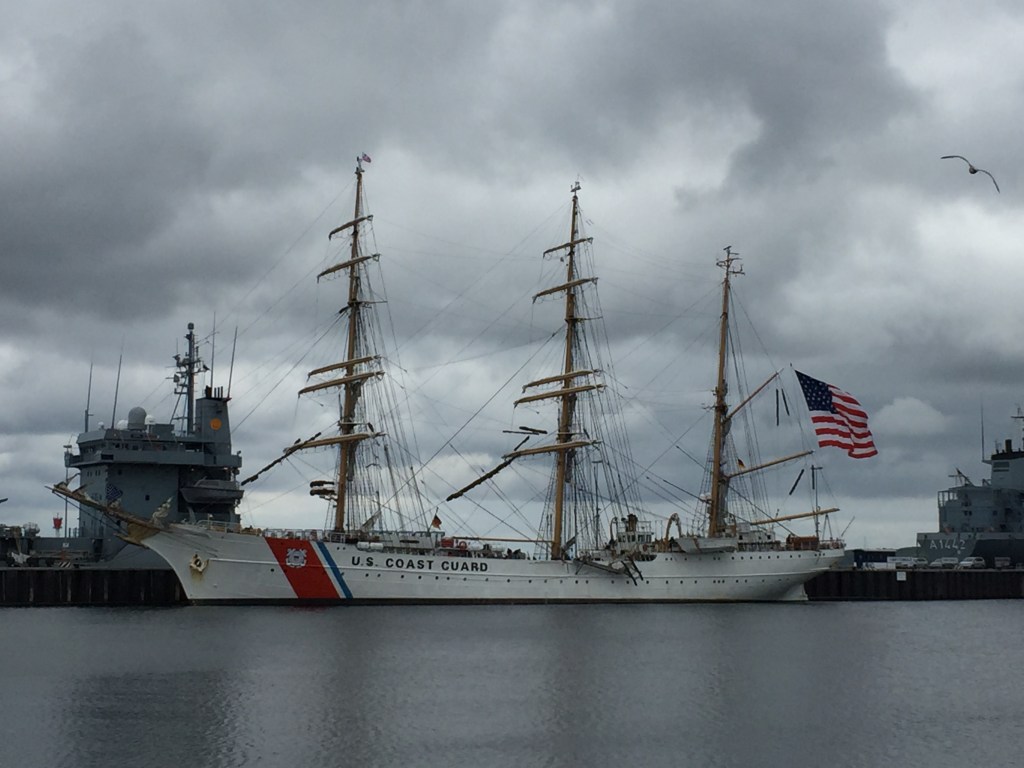
The story of the USCGC Eagle and the German Gorch Fock II is a masterclass in engineering longevity and pedagogical consistency. Born from the same pre-war German maritime vision, they have evolved to serve two distinct democracies, yet their core mission remains unchanged.
Being sisterships, the Eagle and the Gorch Fock II also serve as possible connectors between the USA and modern Germany, which has been shown be mutual visits over the last decades. My personal hope is that those visits will start again, maybe as a symbol for a renewed relationship between the two nations.
Safe seas!


Kommentar verfassen