When Hurricane Katrina hit the U.S. coast on August 29, 2005, it brought terrible destruction with it. But it was much more than a hurricane, as USCG Vice Admiral Thad Allen put it:
“[…] a lot of people think this was a hurricane. I call it a hybrid event. What we had was a city that was impacted by a major hurricane… But what you had then was the back-flooding of the city, when the water that got pushed up to the northwest shore of Lake Pontchartrain came back down when the wind reversed and was driven into canals—that caused the back-flooding in the city.”
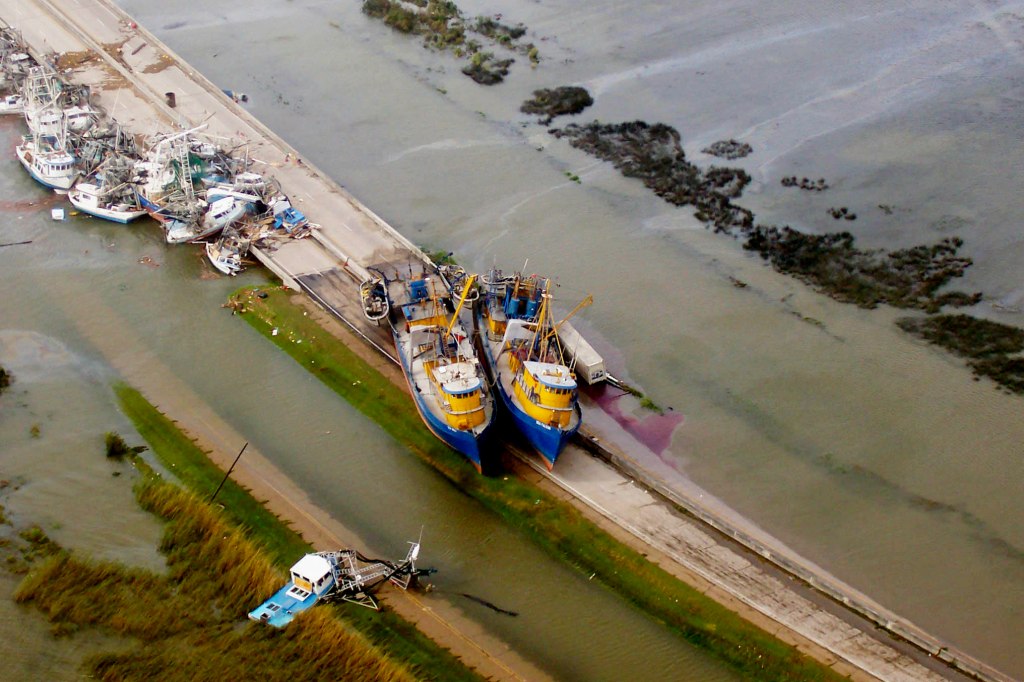
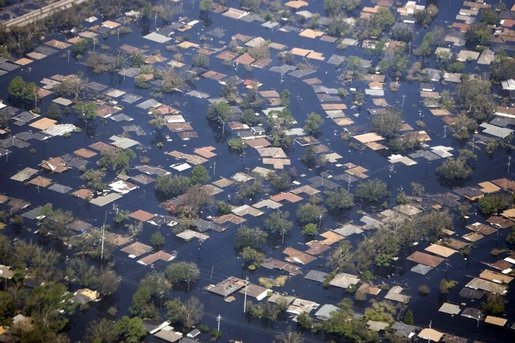
The danger was not only the wind and falling trees, rooftops, and flying objects. The storm brought massive amounts of water, leading to levee breaches and the flooding of 80 percent of New Orleans. VADM Allen identified why the U.S. Coast Guard was so successful with their search and rescue (SAR) missions:
“. .we expect that our operational commanders will exercise ‘on-scene initiative.’ When we were cut off from higher echelons and communications weren’t working down there, everybody knew how to do their job, and they did the right thing and they did what was expected of them.”
It is this mindset that proved crucial for the success of the SAR missions. For example, Station Gulfport personnel were underway for 396 hours during 36 vessel sorties. In total, 76 aircraft and 42 cutters participated in the massive response.
The Philosophy: Centralized Command, Decentralized Execution
The main factor for this success is ingrained in the organization’s DNA. Adaptability and „out-of-the-box“ thinking are key to Coast Guard missions. As RADM Duncan noted:
“Our culture is one of service—it’s always our top priority… We’re a multi-mission organization and see ourselves as service-oriented. We can shift mission priorities in the middle of a flight.”
This ability to find solutions in difficult situations is expected of every member, from the highest to the lowest rank.
Case Study 1: The MacGyvers of the Sky
Standardized training allowed members from all over the country to work together seamlessly. However, their standard tools were not designed for an urban flood. Many residents were trapped in attics with water rising beneath them.
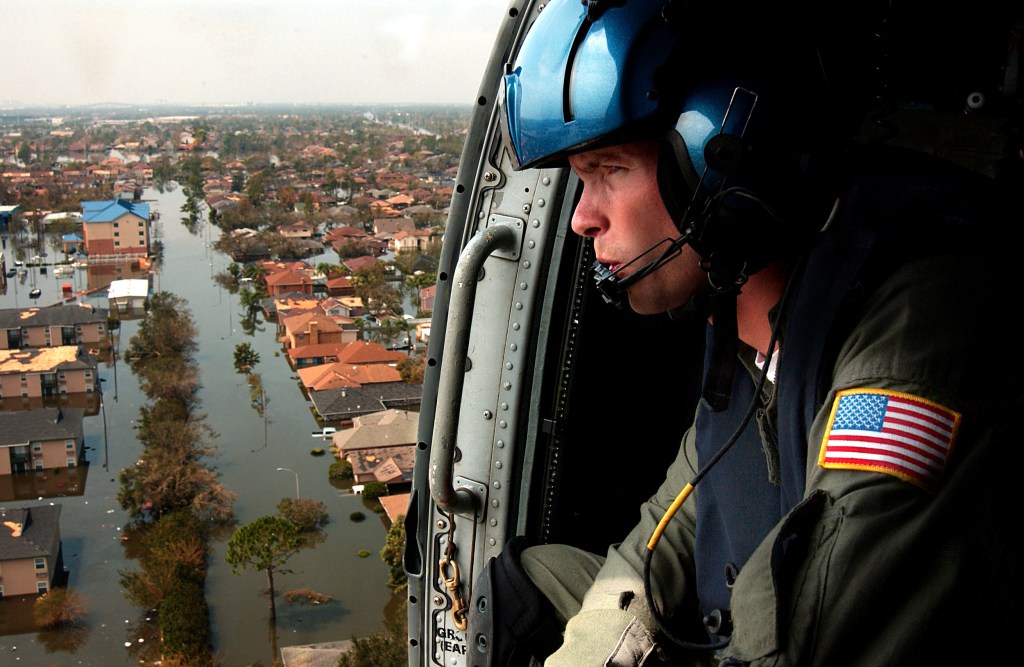
New Orleans (Aug. 30, 2005) Ð U.S. Coast Guard Petty Officer 2nd Class Shawn Beaty of Long Island, N.Y., looks for survivors in the wake of Hurricane Katrina as he flies in a HH-60J Jayhawk helicopter over New Orleans. Petty Officer Beaty is a member of an HH-60J Jayhawk helicopter rescue crew sent from Clearwater, Fla., to assist in search and rescue efforts. Katrina, a Category 4 hurricane, came ashore at approximately 7:10 a.m. EST near the Louisiana bayou town of Buras. U.S. Coast Guard photo by Petty Officer 2nd Class NyxoLyno Cangemi (RELEASED)
The small crash axes on the helicopters proved insufficient for cutting through thick rooftops. After initially borrowing axes from local firefighters, the Coast Guard took their own initiative. The Executive Officer (XO) sent personnel to a local Home Depot to buy every wood axe and saw they could find to outfit the rescue swimmers. This allowed crews to rescue thousands without needing a central coordination grid.
Case Study 2: The „Dunkirk Option“ and the Ad-Hoc Armada
While orange helicopters dominated the news, a parallel „Dunkirk Option“ unfolded on the rising waters of the Mississippi River. Rear Admiral Robert Duncan used this term to describe the unheralded fleet of river tenders and small craft that found „missions of opportunity„.
- The Boat Force Response: At the center was the Pamlico, a 160-foot construction tender. Its crew didn’t wait for formal tasking; instead, they headed downriver toward New Orleans to see what they could do. This improvised fleet eventually moved 750 people per hour by boat at its peak—a rate higher than the aerial rescues.
- Commandeering the Solution: When thousands were ferried to the west bank but had no transportation further inland, Petty Officer Thomas Faulkenberry and Seaman Justin Witt worked with local police to commandeer abandoned city and school buses. They personally evacuated over 100 survivors and established an impromptu medical triage center.
- Security on the Fly: To manage crowds in a volatile environment, crews established „amnesty boxes“ at evacuation points. Incoming residents were told that weapons, alcohol, and narcotics could be dropped inside with „no questions asked“. This resulted in the collection of 500 to 600 firearms, allowing the mission to continue safely.
In total, surface forces saved or evacuated 21,200 people. As CWO3 Robert Lewald noted: „You know a couple words pass between a couple of sailors and the job gets done“.
The Foundation: Why Initiative Isn’t Chaos
This initiative didn’t lead to chaos but to a massive success, rescuing and evacuating a total of 33,735 people. Several factors contributed to this:
- Standardized Training: This enabled a swimmer from Kodiak to work with a pilot from Detroit perfectly, as the training was the same everywhere.
- Trust: Standardized training built trust between leadership and the field.
- Decentralized Command: U.S. Coast Guard Command trusted personnel to make right choices without micromanagement.
Conclusion: A Better Coast Guard
The real legacy of Hurricane Katrina isn’t in the record books, but in the „Katrina veterans“ who now lead the service. They learned early that when the radios go silent, you don’t wait for a memo—you find a way to get the job done. By empowering every member with the „Principle of On-Scene Initiative,“ the Coast Guard proved that a culture of decentralized execution is far more resilient than any rigid, top-down hierarchy.
Ultimately, these events demonstrated that the most valuable asset in a crisis isn’t a better plan; it’s a culture that trusts its people. By blending standardized training with an unwavering „can-do“ attitude, the Coast Guard became a bright light on a very dark day.
Source: https://media.defense.gov/2024/Jun/21/2003490008/-1/-1/0/DARKESTDAY-001.PDF (28.04.2026).
 Semper Paratus: A Historian’s Log
