Semper Paratus: A Historian’s Log

Schlagwort: CG

  • Decoding the Secret Language of the Coast Guard

    The Hook

    In the military, every branch speaks its own language. The dialect of the U.S. Coast Guard is special, though. It not only has a long history, but it developed from a great variety of maritime traditions, mostly due to the hybrid nature of the service. The modern U.S. Coast Guard evolved from a blend of Alexander Hamilton’s Revenue Cutter Service (1790) and the gritty U.S. Life-Saving Service (1848).

    Join me on a tour through some of the most interesting, compelling, and downright weird slang words used by the USCG.

    Section 1: The Identity Crisis (Nicknames & Ships)

    „Puddle Pirate“

    The Navy’s favorite nickname for the Coast Guard is one of the best-known colloquialisms in the military. What makes it so funny is the stark contrast to the historical reality of the brutal, high-stakes life-saving operations carried out by the service. Anyone who has ever seen a 47-foot Motor Life Boat pitchpole backward into a wall of freezing surf would never call a Coastie a „puddle pirate“ with a straight face. Still, mutual teasing has been a staple of military culture since the dawn of time, and modern Coast Guardsmen have largely reclaimed the term with pride.

    „Cutter“

    Another unique linguistic staple within the service is the word Cutter. Even today, official doctrine dictates that:

    „The term ‚cutter‘ identifies a Coast Guard vessel 65 feet in length or greater, with accommodations for a crew to live aboard.“ (USCG.mil Data Sheet, 2026)

    This word traces its roots directly back to Hamilton’s original ten single-masted sailing vessels. Those historic ships were physically designed to literally „cut“ through the water with maximum speed to chase down and catch agile smugglers on the run.
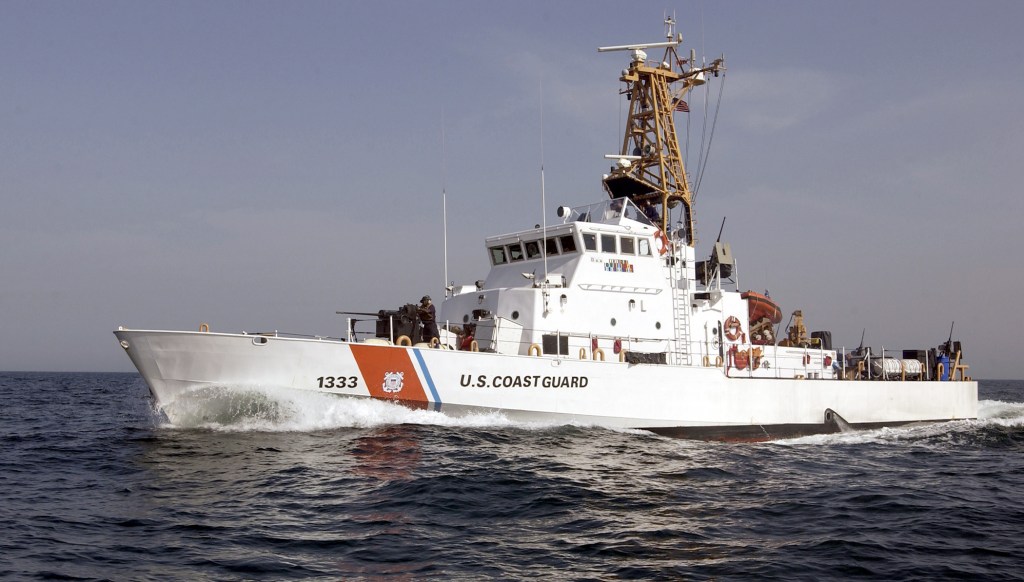
    NORTH ARABIAN GULF (March 6, 2003)–The U.S. Coast Guard Cutter Adak, a 110 foot patrol boat, homeported in Highlands, NJ., patrols the North Arabian Sea off the Coast of Iraq March 6, 2003. The Adak is on one of four 110 foot Coast Guard patrol boats in the Persian Gulf in support of Operation Iraqi Freedom. USCG photo by PA1 Tom Sperduto

    Section 2: Everyday Shipboard Sorcery (Life on the Water)

    To understand Coast Guard culture, you have to understand that once you enlist, you never truly step foot on dry land again—at least, not psychologically. The language of the sea completely rewrites how a person perceives their physical surroundings, transforming ordinary objects into living artifacts of maritime history.

    The Wooden Office: Bulkhead, Overhead, and Deck

    If you walk into a recruitment office or a land-based sector headquarters in the dead-center of the American Midwest—thousands of miles from the nearest saltwater—you will not find any walls, ceilings, or floors. To a civilian, it’s a brick-and-mortar office building. To a Coast Guardsman, it is a ship.

    The floor is always the deck. The ceiling is the overhead. The walls are bulkheads. This isn’t just stubborn roleplay; it’s a foundational psychological shift. The term bulkhead originally referred to the heavy upright wooden partitions built into a ship’s hull to create watertight compartments. If a hull breached, those bulkheads kept the ocean out and the crew alive. By forcing recruits to call an ordinary drywall partition a bulkhead, the service instills an immediate, instinctual spatial awareness. On duty, you are always aboard a vessel, and everyone is responsible for keeping her watertight.

    „Scuttlebutt“: The Original Water Cooler

    Long before corporate cubicles existed, humans still found a way to slack off, gather in small groups, and whisper about what management was doing wrong. In the modern office, we call it „water-cooler talk.“ In the maritime services, it’s scuttlebutt.

    The etymology here is purely structural. On an old wooden sailing ship, a butt was a large wooden cask used to store fresh water. A scuttle was a small hole intentionally cut into a deck or a hatchway. Therefore, the scuttlebutt was a fresh-water barrel that had been tapped (scuttled) so the crew could pitch in with a ladle and get a drink.

    Because it was the only place on a strict, grueling voyage where sailors from different watches could legitimately pause for a quick break, it naturally became the ship’s informational clearinghouse. Sailors traded wild rumors about upcoming port calls, complained about the rations, and swapped tall tales. Over the centuries, the wooden barrel disappeared, replaced by modern drinking fountains, but the word survived. When a Coastie tells you they heard some juicy scuttlebutt, they are participating in a tradition as old as Alexander Hamilton’s first fleet.

    „Charlie Noble“: The Legend of the Polished Smokestack

    If you look at the galley (kitchen) exhaust pipe sticking out of a Coast Guard cutter, you are looking at Charlie Noble. To anyone else, it’s a chimney. To a sailor, it’s a monument to one man’s obsessive-compulsive neatness.

    The phrase dates back to the mid-19th century and is widely attributed to a British merchant captain named Charles Noble. Captain Noble was a man possessed by a fanatical desire for shipboard symmetry and cleanliness. Upon taking command of a new vessel, he noticed that the exhaust funnel coming from the galley’s cookstove was made of solid copper. While a normal captain would let the soot and sea spray turn the pipe a dull green, Noble ordered his crew to polish the copper chimney until it shone like a mirror. The grueling, soot-stained, highly frustrating task of polishing a working chimney became a legendary running joke across the Atlantic. Soon, any galley smokestack was universally dubbed a „Charlie Noble.“ Today, the Coast Guard still uses the name, serving as a daily reminder that in the maritime world, if it moves, you salute it; if it doesn’t, you polish it.

    Section 3: The Human Measure

    „Fathom“

    he word Fathom is still heavily in use today, officially defined as:

    „…a unit of length in the imperial and U.S. customary systems equal to 6 feet (1.8288 m), used especially for measuring the depth of water.“ (Wikipedia, 2026)

    But long before it was standardized on digital depth sounders, a fathom had a profoundly human origin. It comes from the Old English word faethm, meaning „embracing arms.“ In the days of sail, deep-sea depth sounding was done entirely by hand. A sailor would drop a weighted lead line over the side of the ship and then haul it back in, stretching the rope hand-to-hand across his chest. The average span of an adult man’s outstretched arms is roughly six feet—the literal length of a human embrace.
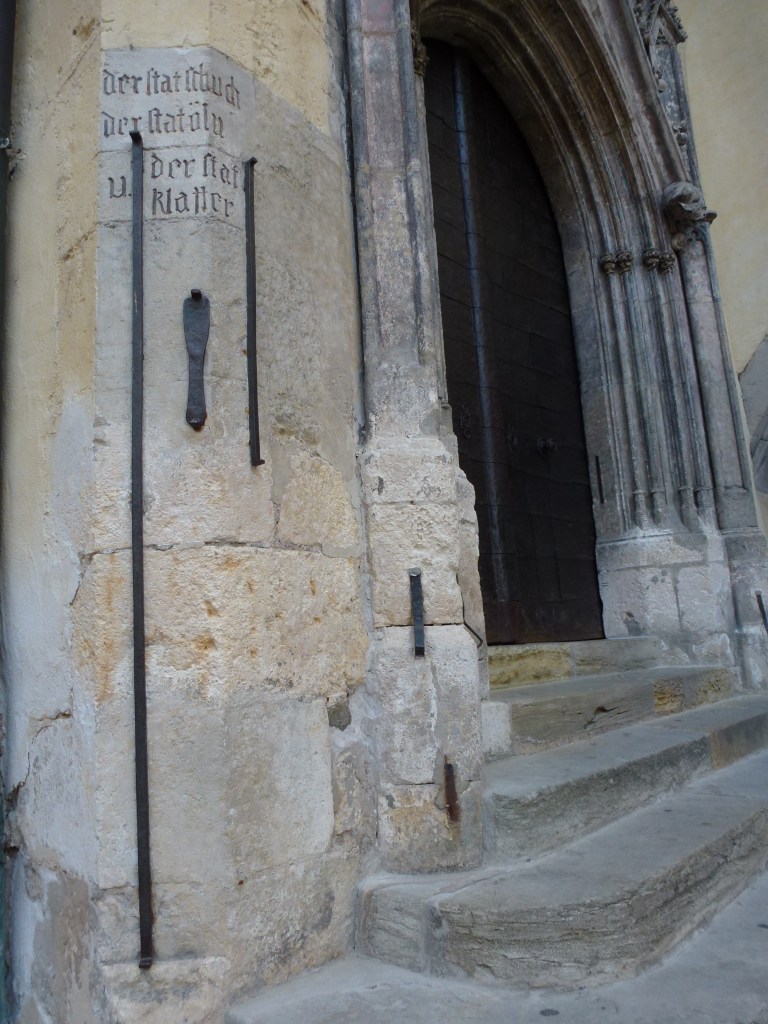
    „the city’s foot, ell and fathom„, Hans Koberger – Own work

    Section 4: The Scale of Bureaucratic Despair (The Acronyms)

    Things go wrong in life—and in the military, they go wrong in very specific degrees. To survive the grinding gears of modern administrative chaos, maritime service members rely on a highly specialized weapon: pitch-black, cynical humor. Nowhere is this more evident than in how a crew uses classic acronyms to instantly communicate the severity of a situation and the exact human reaction required to survive it.

    The Analytical Breakdown: Gauging a Bad Day

    TermSeverity LevelThe Operational RealityThe Human Reaction
    SNAFULow to MediumSituation Normal: All Fouled Up. Standard operational friction. The printer jams during a high-stakes briefing; the radio drops signal in heavy rain.A heavy sigh, a shake of the head, and pouring another cup of terrible galley coffee.
    BOHICAMedium to HeavyBend Over, Here It Comes Again. Inevitable bureaucratic or logistical pain. The crew just spent 48 hours scrubbing the cutter for an inspection, only to be told it’s canceled and they must immediately load 10 tons of cargo instead.Dark, collective laughter among the lower ranks. A shared glance that says, “Here we go again.”
    FUBARMaximumFouled Up Beyond All Recognition. Total structural or situational collapse. The cutter’s main diesel engine suffers a catastrophic mechanical failure mid-patrol, leaving the vessel dead in the water during a storm.Immediate damage control. The jokes stop, adrenaline kicks in, and it’s time to call for a tow.

    While civilians often think the word „Fouled“ in these polite versions is just a modern, PG clean-up to avoid swearing, it is actually a deeply authentic nautical term. In seamanship, a „fouled anchor“ occurs when the anchor chain becomes hopelessly tangled around its own hardware. A fouled anchor cannot grab the ocean floor, leaving the ship entirely at the mercy of the wind and rocks. When a Coastie says a day is „all fouled up,“ they are using a 300-year-old metaphor to tell you they’ve lost their anchor and chaos is taking the wheel.

    The Anchor: Conclusion

    As we can see, maritime slang is nothing static. It develops over time and grants us a living window into the culture of a service. When we look at the unique vocabulary of the USCG, we can see clearly how it navigated its many developmental stages throughout history—evolving from an 18th-century fleet dedicated to collecting taxes and tariff duties, to high-seas hunters, and ultimately transforming into the premier life-saving organization in the world.
  • Always Ready, Always First: The Coast Guard’s Secret History of „Firsts“

    The Only Game in Town (1790–1798)

    Did you know that the US Coast Guard was the only maritime force of the newly founded United States of America from 1790 – 1798 The Continental Navy had been disbanded in 1785, so the only US warships remaining were “the Cutters”. They had several tasks: Protecting the coast and to enforce national law, especially the laws concerning tariffs.

    The first commission to officer was that of Captain Hopley Yeaton of New Hampshire by President George Washington. The service itself was created in the Act of 4 August 1790.

    Although the Cutter Service hired mostly former Navy personnel, the early cuttermen were paid and fed based on Army scales (cf. https://media.defense.gov/2023/Mar/23/2003185264/-1/-1/0/1987_SCHEINA_CG_AT_WAR.PDF, p. 2).

    The War of 1812: Bravery and „Logbook Bullets“

    It did not take long for the cutters to be involved in fights. While they pursued and arrested pirates in the early years of their service, their military role was formalized in the years 1797 and 1799. Their tasks now included the active protection of US ships near its coasts as well as the coasts itself. It was now also possible to assign US Marines to cutters (cf. https://media.defense.gov/2023/Mar/23/2003185264/-1/-1/0/1987_SCHEINA_CG_AT_WAR.PDF, p. 3). As we can see, the Cutter Service was not only a life-saving organization in its early days – essentially, it was the Navy of the USA during that time.

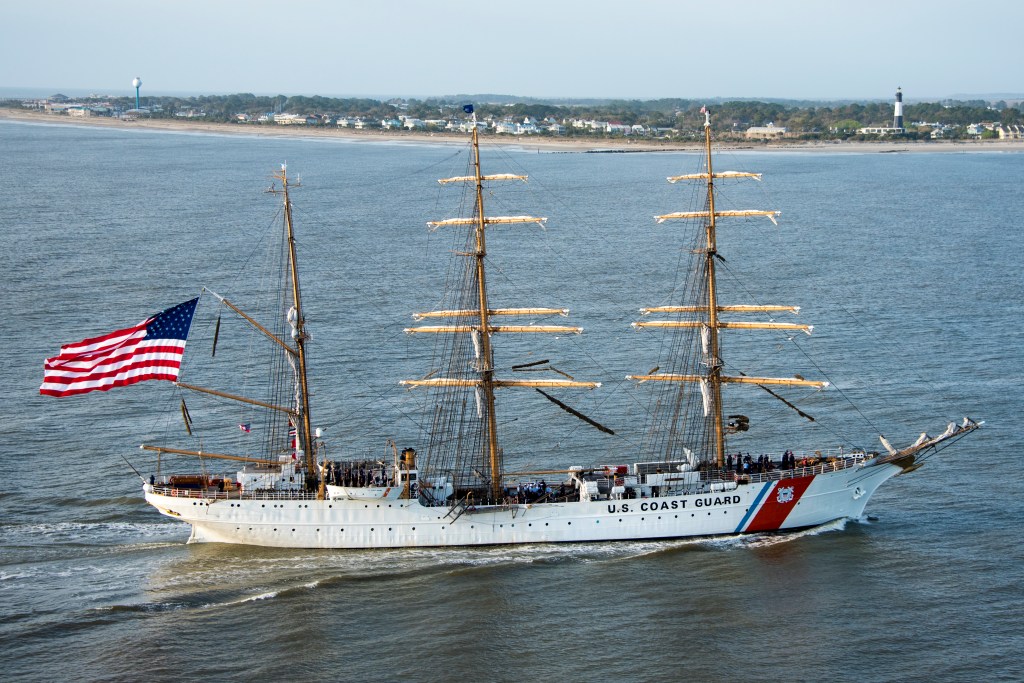
    But even after the US Navy was created, the cutters took on military tasks. In the war with Great Britain 1812 the encounter of the US cutter “Eagle”, which Is used to train recruits today, with the British brig “Dispatch” became famous. The “Eagle” was run ashore on Long Island on purpose and the cuttermen pulled the guns onto  a small hill, fighting the British from 9 o’clock in the morning to the late afternoon. In the end, they even used the pages of the ship’s logbook as wadding for the cannons. A brave deed, although they had to surrender eventually. Today, the USCG still uses a sailship with the name “Eagle”, to represent the Coast Guard and to train recruits. It is worth mentioning that the 1812 Eagle was not the same ship, but a smaller cutter of that era.

    Coast Guard Cutter Eagle transits down the Savannah River towards Savannah, Georgia, Mar. 15, 2019, in front of the Tybee Island Lighthouse. The Eagle arrived in Savannah for St. Patrick’s Day weekend with over 100 guests on board. (U.S. Coast Guard photo by Petty Officer 3rd Class Ryan Dickinson)

    Civil War: The First Shots

    The first shots of the Civil War, at least at sea, were fired by the cutter “Harriet Lane” when they tried to stop the steamer “Nashville” from entering Charlston Harbor without flying the flag of the USA. From 1862 to 1864 the cutters “Hercules” and “Reliance” were involved in direct fighting with Confederate troops. In 1865, cutters were involved in searching outgoing ships for the assassins of Abraham Lincoln.

    It was during this time when the Cutter Service received its first official name: The Revenue Cutter Service (cf. https://media.defense.gov/2023/Mar/23/2003185264/-1/-1/0/1987_SCHEINA_CG_AT_WAR.PDF, pp. 11-12).

    Modern „Firsts“ and Innovations

    During the early days of World War II, the US Coast Guard focused on the protection of US waters. Soon it became involved in more far-reaching operations, especially in cold waters. In the spring of 1941 the cutter “Northland” captured the Norwegian trawler “Boskoe”, which had three German radiomen aboard – a successful act of counter-espionage and the first US naval capture of the war. (cf. https://media.defense.gov/2023/Mar/23/2003185264/-1/-1/0/1987_SCHEINA_CG_AT_WAR.PDF, pp. 19-20).

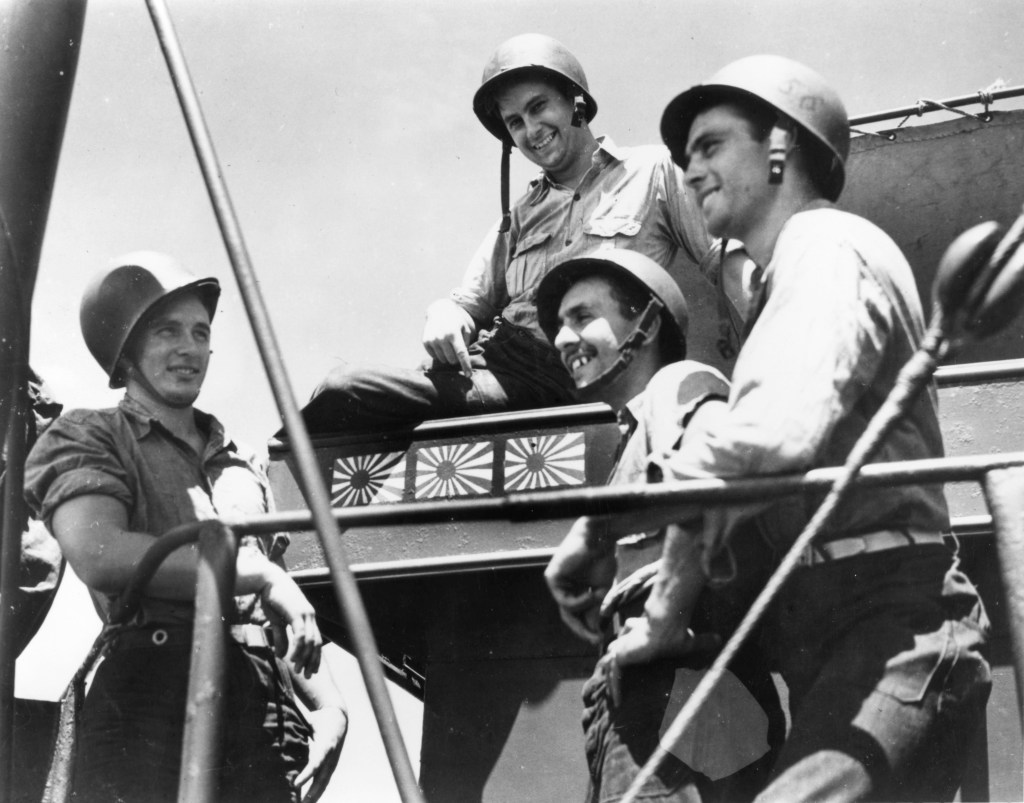
    When the USA entered the war fully, the Coast Guard became part of the Navy. Tasks included the protection of convoys, hunting of enemy submarines and the assistance in landing operations. Coast Guard members also trained people in the use of amphibious vehicles.

    At Sea – Coast Guardsmen Aboard an LST in the Pacific

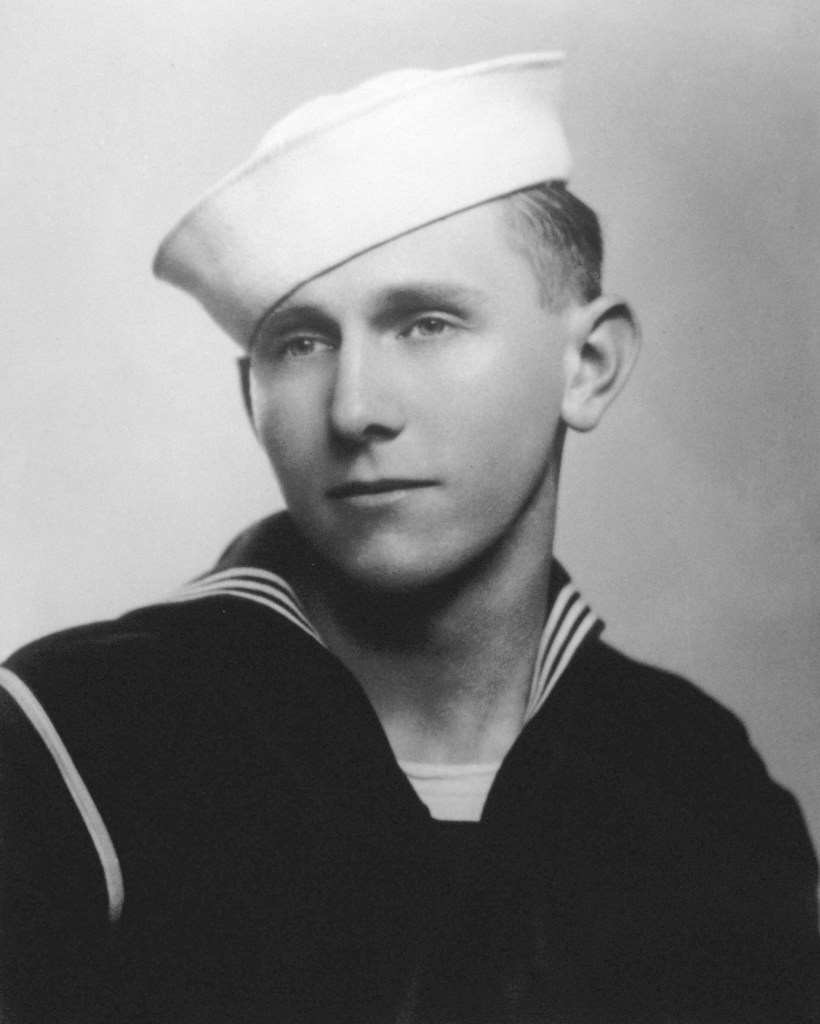
    Signalman First Class Douglas Munro is distinguished in military history for his extraordinary bravery at Guadalcanal. His actions earned him the Congressional Medal of Honor, making him the only member of the Coast Guard to ever receive this prestigious award. While the service saw nearly 2,000 of its members decorated during World War II, Munro stands alone as its sole recipient of the nation’s highest military honor.

    Douglas Monro memorial service. Grave, honor guard, historical photos at the memorial site.

    But even while being tasked with combat roles, the Coast Guard also did what it could do best – rescuing people in need. During the war they saved 1.500 survivors of torpedo-attacks in the waters near the US, 1.000 survivors were saved by cutters driving with the convoys and 1.500 were rescued during D-Day. A total of 1.918 Coast Guard members died during the war, giving the life in the fight against evil and tyranny. (cf. https://media.defense.gov/2023/Mar/23/2003185264/-1/-1/0/1987_SCHEINA_CG_AT_WAR.PDF, pp. 19-20).

    Vietnam: Inshore Innovation and Port Security

    In the mid-1960s, the U.S. Navy found itself lacking the shallow-water craft necessary for inshore operations in South Vietnam. To fill this critical gap, the Coast Guard deployed 26 82-foot cutters to form Squadron One, which patrolled the coast to intercept contraband and North Vietnamese vessels. These cutters spent roughly 70% of their time underway and became famous for a unique Coast Guard innovation: the „marriage“ of a .50 caliber machine gun and an 81mm mortar. This weapon system provided highly effective naval gunfire support that saved numerous friendly outposts from being overrun by the Viet Cong.

    Conclusion: A Legacy of Versatility

    From the first commission signed by Washington to the shallow-water patrols of the Vietnam War, the U.S. Coast Guard has proven itself to be a unique hybrid of humanitarian mercy and military might. Whether they were firing back British cannonballs or developing the 81mm mortar/machine gun marriage for riverine combat, these „cuttermen“ have consistently been the first to answer the call. The history of the Coast Guard is a reminder that being „Always Ready“ means more than just standing by—it means being the first ones in the fight when the nation needs it most.

    Source: https://media.defense.gov/2023/Mar/23/2003185264/-1/-1/0/1987_SCHEINA_CG_AT_WAR.PDF

  • The „Katrina Veteran“ Mindset: How On-Scene Initiative Saved 33,000 Lives

    When Hurricane Katrina hit the U.S. coast on August 29, 2005, it brought terrible destruction with it. But it was much more than a hurricane, as USCG Vice Admiral Thad Allen put it:

    “[…] a lot of people think this was a hurricane. I call it a hybrid event. What we had was a city that was impacted by a major hurricane… But what you had then was the back-flooding of the city, when the water that got pushed up to the northwest shore of Lake Pontchartrain came back down when the wind reversed and was driven into canals—that caused the back-flooding in the city.”

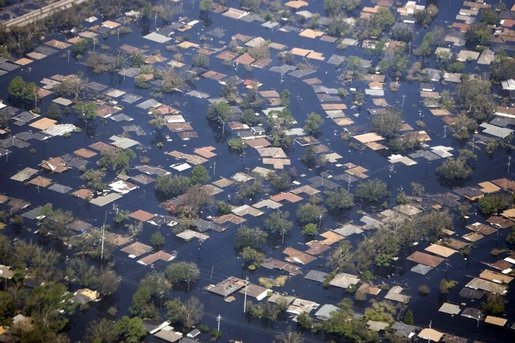
    The danger was not only the wind and falling trees, rooftops, and flying objects. The storm brought massive amounts of water, leading to levee breaches and the flooding of 80 percent of New Orleans. VADM Allen identified why the U.S. Coast Guard was so successful with their search and rescue (SAR) missions:

    “. .we expect that our operational commanders will exercise ‘on-scene initiative.’ When we were cut off from higher echelons and communications weren’t working down there, everybody knew how to do their job, and they did the right thing and they did what was expected of them.”

    It is this mindset that proved crucial for the success of the SAR missions. For example, Station Gulfport personnel were underway for 396 hours during 36 vessel sorties. In total, 76 aircraft and 42 cutters participated in the massive response.

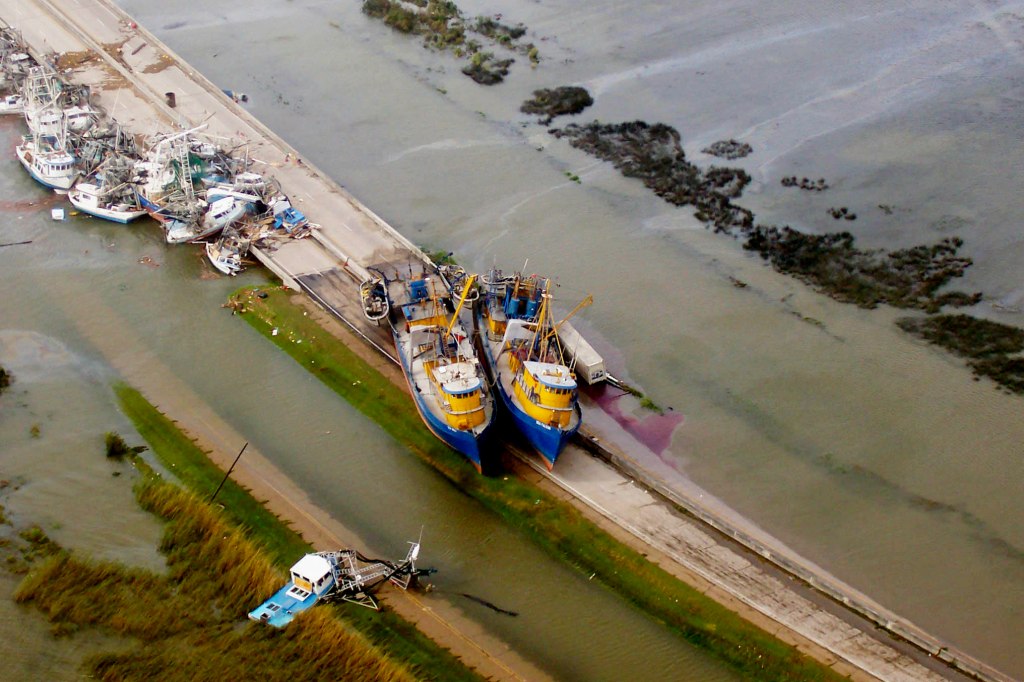
    „NOAA“ – http://www.noaanews.noaa.gov/stories2005/images/katrina-fishing-vessels-stranded-empire-la-08-29-2005.jpg as linked by http://www.noaanews.noaa.gov/stories2005/s2494.htm

    The Philosophy: Centralized Command, Decentralized Execution

    The main factor for this success is ingrained in the organization’s DNA. Adaptability and „out-of-the-box“ thinking are key to Coast Guard missions. As RADM Duncan noted:

    “Our culture is one of service—it’s always our top priority… We’re a multi-mission organization and see ourselves as service-oriented. We can shift mission priorities in the middle of a flight.”

    This ability to find solutions in difficult situations is expected of every member, from the highest to the lowest rank.

    Case Study 1: The MacGyvers of the Sky

    Standardized training allowed members from all over the country to work together seamlessly. However, their standard tools were not designed for an urban flood. Many residents were trapped in attics with water rising beneath them.

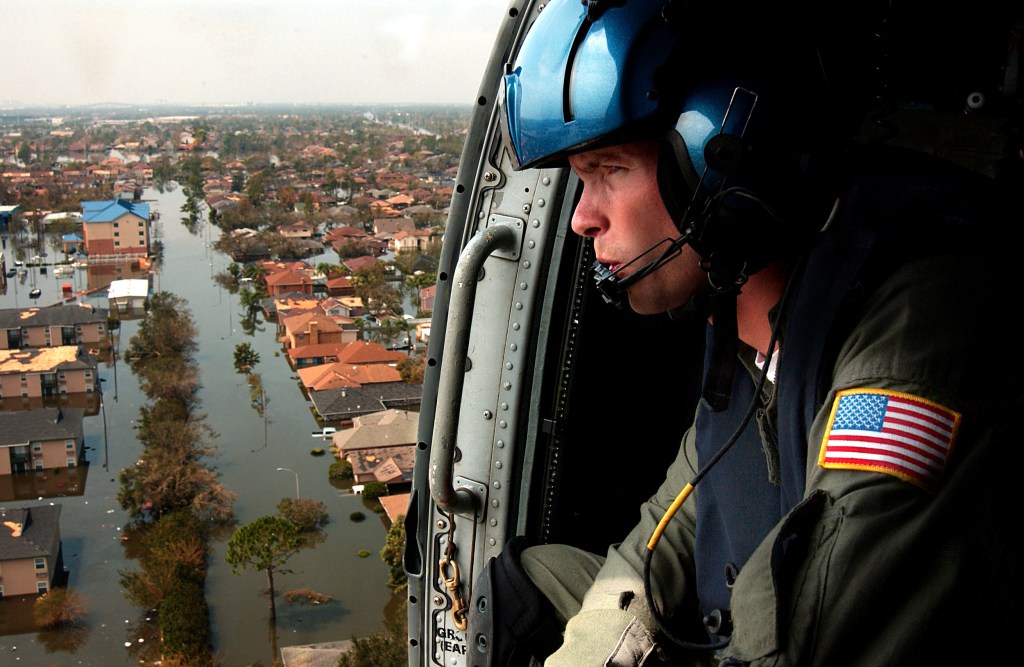
    050830-C-3721C-032
    New Orleans (Aug. 30, 2005) Ð U.S. Coast Guard Petty Officer 2nd Class Shawn Beaty of Long Island, N.Y., looks for survivors in the wake of Hurricane Katrina as he flies in a HH-60J Jayhawk helicopter over New Orleans. Petty Officer Beaty is a member of an HH-60J Jayhawk helicopter rescue crew sent from Clearwater, Fla., to assist in search and rescue efforts. Katrina, a Category 4 hurricane, came ashore at approximately 7:10 a.m. EST near the Louisiana bayou town of Buras. U.S. Coast Guard photo by Petty Officer 2nd Class NyxoLyno Cangemi (RELEASED)

    The small crash axes on the helicopters proved insufficient for cutting through thick rooftops. After initially borrowing axes from local firefighters, the Coast Guard took their own initiative. The Executive Officer (XO) sent personnel to a local Home Depot to buy every wood axe and saw they could find to outfit the rescue swimmers. This allowed crews to rescue thousands without needing a central coordination grid.

    GWB: Flooding caused by Hurricane Katrina in the New Orleans area is visible from Air Force One Wednesday, Aug. 31, 2005, as President Bush was alble to survey the ravages of the storm during his return from Crawford, Texas to Washington D.C. White House photo by Paul Morse

    Case Study 2: The „Dunkirk Option“ and the Ad-Hoc Armada

    While orange helicopters dominated the news, a parallel „Dunkirk Option“ unfolded on the rising waters of the Mississippi River. Rear Admiral Robert Duncan used this term to describe the unheralded fleet of river tenders and small craft that found „missions of opportunity„.

    • The Boat Force Response: At the center was the Pamlico, a 160-foot construction tender. Its crew didn’t wait for formal tasking; instead, they headed downriver toward New Orleans to see what they could do. This improvised fleet eventually moved 750 people per hour by boat at its peak—a rate higher than the aerial rescues.
    • Commandeering the Solution: When thousands were ferried to the west bank but had no transportation further inland, Petty Officer Thomas Faulkenberry and Seaman Justin Witt worked with local police to commandeer abandoned city and school buses. They personally evacuated over 100 survivors and established an impromptu medical triage center.
    • Security on the Fly: To manage crowds in a volatile environment, crews established „amnesty boxes“ at evacuation points. Incoming residents were told that weapons, alcohol, and narcotics could be dropped inside with „no questions asked“. This resulted in the collection of 500 to 600 firearms, allowing the mission to continue safely.

    In total, surface forces saved or evacuated 21,200 people. As CWO3 Robert Lewald noted: „You know a couple words pass between a couple of sailors and the job gets done“.

    The Foundation: Why Initiative Isn’t Chaos

    This initiative didn’t lead to chaos but to a massive success, rescuing and evacuating a total of 33,735 people. Several factors contributed to this:

    • Standardized Training: This enabled a swimmer from Kodiak to work with a pilot from Detroit perfectly, as the training was the same everywhere.
    • Trust: Standardized training built trust between leadership and the field.
    • Decentralized Command: U.S. Coast Guard Command trusted personnel to make right choices without micromanagement.

    Conclusion: A Better Coast Guard

    The real legacy of Hurricane Katrina isn’t in the record books, but in the „Katrina veterans“ who now lead the service. They learned early that when the radios go silent, you don’t wait for a memo—you find a way to get the job done. By empowering every member with the „Principle of On-Scene Initiative,“ the Coast Guard proved that a culture of decentralized execution is far more resilient than any rigid, top-down hierarchy.

    Ultimately, these events demonstrated that the most valuable asset in a crisis isn’t a better plan; it’s a culture that trusts its people. By blending standardized training with an unwavering „can-do“ attitude, the Coast Guard became a bright light on a very dark day.

    Source: https://media.defense.gov/2024/Jun/21/2003490008/-1/-1/0/DARKESTDAY-001.PDF (28.04.2026).

  • Visible Symbols of Authority: A History of the U.S. Coast Guard Uniform

    In the early days of the United States of America, there was the Revenue Cutter Service, founded by Alexander Hamilton. Until the US Navy was reestablished in 1797, the Revenue Cutter Service was the new country’s only naval service, which brought with it an enormous amount of responsibility and the need for a professional structure – rank and status, as well as a fitting symbolism. A uniform had to be designed. The way to the USCG uniforms of today has been a long one, including many changes and challenges along the way.

    Little is known about the earliest uniforms of the Service, since its archives had been destroyed by the British in 1814 and a fire in 1833. However, it is safe to assume that the early officer uniforms looked very similar to that of the Navy – a blue coat with red lapels and cuffs, yellow brass buttons, a red waitcoat, blue breeches, white stockings and a tri-cornered hat. The seamen were dressed in much more practical pieces that allowed freedom in movement and could withstand a hard day’s work on deck.

    There were no written regulations yet, though. The first appeared in 1830 under Treasury Secretary Samuel D. Ingham:

    The Captain’s Full Dress

    The 1830 captain’s uniform was a striking blue ensemble defined by an „abundance of yellow braid trim“.

    • The Coat: This blue coat featured nine buttons on each lapel, two on the collar, four on the cuffs, and six on the skirts.
    • The Braid: Yellow braid was used extensively, closing every seam of the coat and the outer seams of the blue pants.
    • The Vest: Underneath the coat, captains wore a nine-button buff-colored vest, which also featured yellow braid on its seams.
    • Headgear: The outfit was topped with a „high crowned“ black hat, decorated with a black cockade and an eagle button on the left side.

    Rank Distinctions for Lieutenants

    While captains were decked out in buttons and braid, lieutenants had slightly more modest requirements to distinguish their rank:

    • Cuff Buttons: First lieutenants wore three buttons on their cuffs, while second lieutenants wore only two.
    • Epaulettes: Instead of two epaulettes, lieutenants wore only one.
    • Placement: The single epaulette was worn on the right shoulder for first lieutenants and on the left shoulder for second lieutenants.
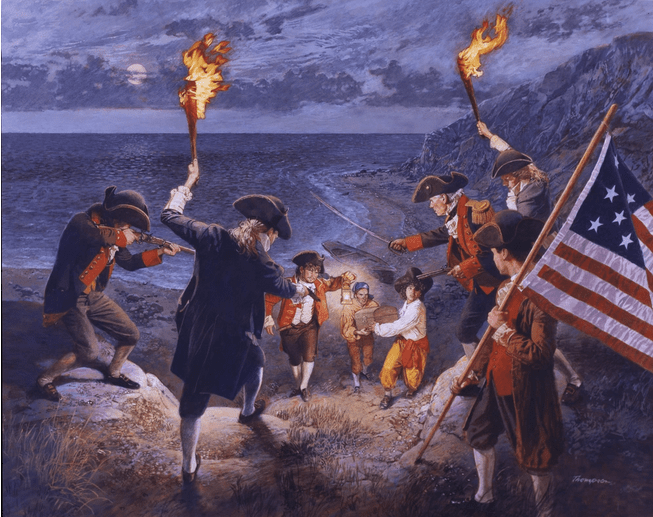
    Captain William Cooke seizes contraband gold from the French Privateer Francois Henri Hervieux near Brunswick, North Carolina in 1793. Early in our nation’s history, privateering by French and Spanish crews presented a serious problem along the Atlantic coast. The revenue cutter Diligence, one of the first ten cutters built for the service, was sent to Wilmington, North Carolina to enforce revenue laws and to deter illegal acts. The Revenue Cutter Service at this time had no ensign and the men had no special uniform; Captain William Cooke, commander of the Diligence, enforced the laws without any visible symbol of authority. This early austerity forced the officers to wear their Revolutionary War uniforms and to carry unused or unissued weapons from other services. (https://www.dvidshub.net/image/1085120/captain-william-cooke-seizes-contraband-john-thompson).

    The Undress Uniform

    For less formal occasions, the „undress“ version of the uniform was used. This version was considerably simpler, dispensing with the extensive yellow braid and replacing the full-dress epaulettes with narrow lace on the shoulders.

    Navy Concerns

    Though these blue uniforms were the new standard, they weren’t exactly a hit. They faced immediate criticism for their excessive trim, leading the service to strip away much of that yellow braid and the collar/cuff buttons just a year later.

    However, these regulations had to be changed only within a year, especially since there were complaints by Navy officers who said that the uniform would be too similar to their own.  The primary source of this resentment was the inclusion of epaulettes, which appeared on a Revenue Service uniform for the first time during this era. The controversy reached a peak at a grand ball in Charleston, South Carolina, where Navy Commodore Jesse D. Elliott was so incensed by the resemblance of the revenue officers‘ attire to his own staff’s that he filed a formal complaint.

    Following this dispute, the following changes occurred:

    • In 1834, Secretary of the Treasury Levi Woodbury directed a board to design a „distinctive“ uniform that excluded the controversial epaulettes.
    • When he could not dissuade the revenue officers from wearing shoulder decorations, Woodbury retaliated by changing the official uniform color to gray.
    • This gray uniform was unanimously disliked by the Revenue Service, with many officers questioning, „Whoever heard of a sailor in a gray uniform?“.
    • Due to its extreme unpopularity, the gray uniform lasted only two years before the service returned to blue in 1836.

    The Mid-19th Century: Distinguishing the Service (1840s–1850s)

    Following the short-lived gray uniform, the service returned to blue but sought new ways to establish a unique identity.

    • Regulation Sidearms (1843): The first official swords were authorized, featuring a Roman hilt and elaborate engravings of a spread eagle and national shield.
    • New Insignia (1844): To further differentiate from the Navy, the Treasury arms (surmounted on an anchor) were added to epaulettes and cap bands.
    • Steam Engineering (1845): The introduction of steam vessels brought the first „engineer“ uniforms, which featured a gold-embroidered Treasury arms device on the collar.
    • Shoulder Strap Standardization (1853): Shoulder straps were officially authorized, using devices like foul anchors, shields, and stars to denote rank when epaulettes were not worn.
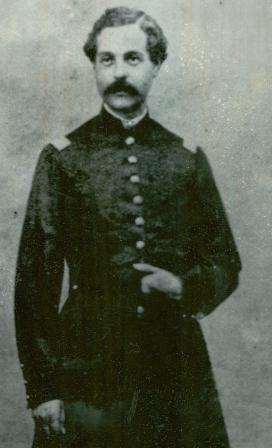
    At Sea – Captain Alexander Vareness Fraser, USRM, Chief, Revenue Marine Bureau, no date

    The Civil War and Post-War Conflict (1862–1873)

    This era saw the service modernize its silhouette while enduring one of its most unpopular design choices.

    • The Frock Coat (1862): The traditional „body coat“ (cutaway) was eliminated in favor of a double-breasted frock coat, identical in cut to the Navy’s Civil War undress uniform.
    • The „U.S.R.M.“ Controversy (1871): New regulations reinstated the swallowtail coat and introduced Old English lettering („U.S.R.M.“) on collars and caps. Officers described these as the „poorest and ugliest“ ornaments ever authorized, and many simply refused to wear them.
    • Standardized Cap Ornament (1873): After the Old English letters were discarded, the service adopted the spread eagle with a shield and foul anchor surrounded by 13 stars—an emblem that remains essentially the same today.

    The Era of the Military Tunic (1891–1915)

    The late 19th century brought a sleek, modern look that would last for decades.

    • The Fly-Front Tunic: This tight-fitting, single-breasted coat featured a concealed button front and black mohair braid trim. It became the standard service coat until the 1920s.
    • Tropical Helmets: For warm climates, a high-crowned cork or linen helmet was authorized, similar to British colonial headgear.
    • Social Full Dress: A cutaway version with a rolling collar, similar to a formal tuxedo, was introduced for social occasions.
    • Rank Evolution (1908): The rank of „Captain Commandant“ was created, designated by four sleeve stripes. This period also introduced „scrambled eggs“ (gold embroidery) on the visors of senior officers‘ caps.
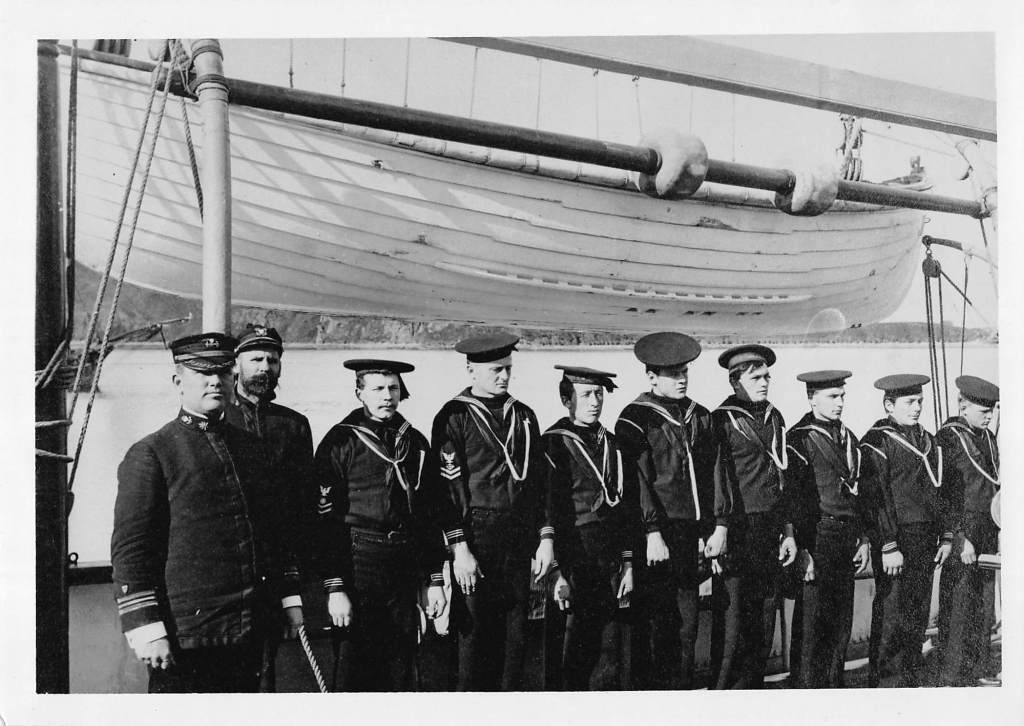
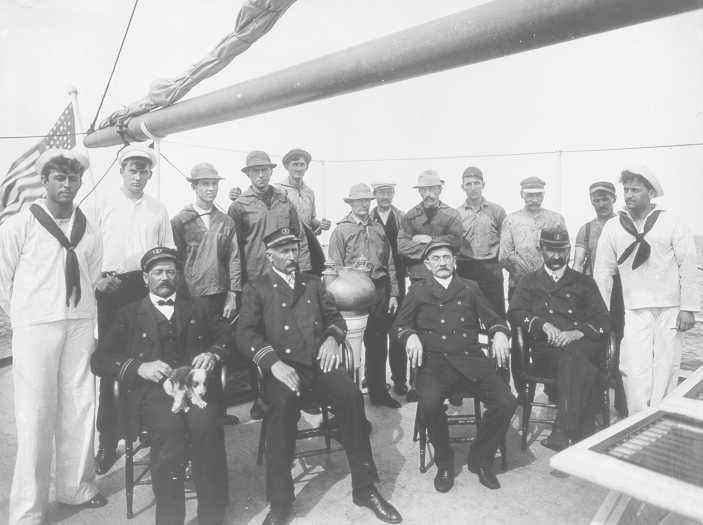
    At Sea – A photo of some of the crew of the Revenue Cutter Manning while on a Bering Sea Patrol showing in nice detail the enlisted uniforms of the period. Photo not dated but circa 1910.

    20th Century: Navy Integration and Modern Distinction

    • The 1920s Transition: The fly-front coat was replaced by a double-breasted service coat similar to the Navy’s. Enlisted men transitioned to the iconic Navy-style white circular „Dixie cup“ hat.
    • Aviation Working Dress (1930): Early aviators wore forest-green gabardine in winter and khaki cotton in summer.
    • Official Modification (1941): Coast Guard uniforms became officially a „modification“ of Navy regulations, making the garments interchangeable except for specific buttons and the Coast Guard shield on the sleeve.
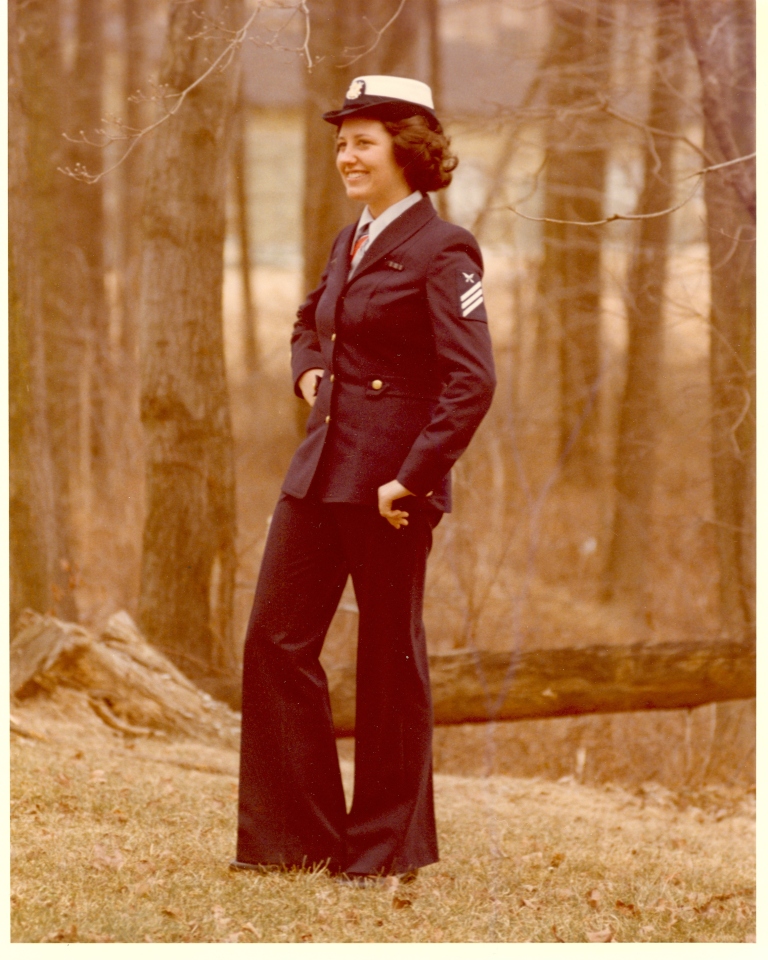
    • „Bender Blue“ (1970s): Under Commandant Chester R. Bender, the service finally broke away from Navy styles to adopt a distinctive lighter-blue, single-breasted uniform to solidify its separate organizational identity.
    Unknown – 1970s New USCG Women’s Uniform
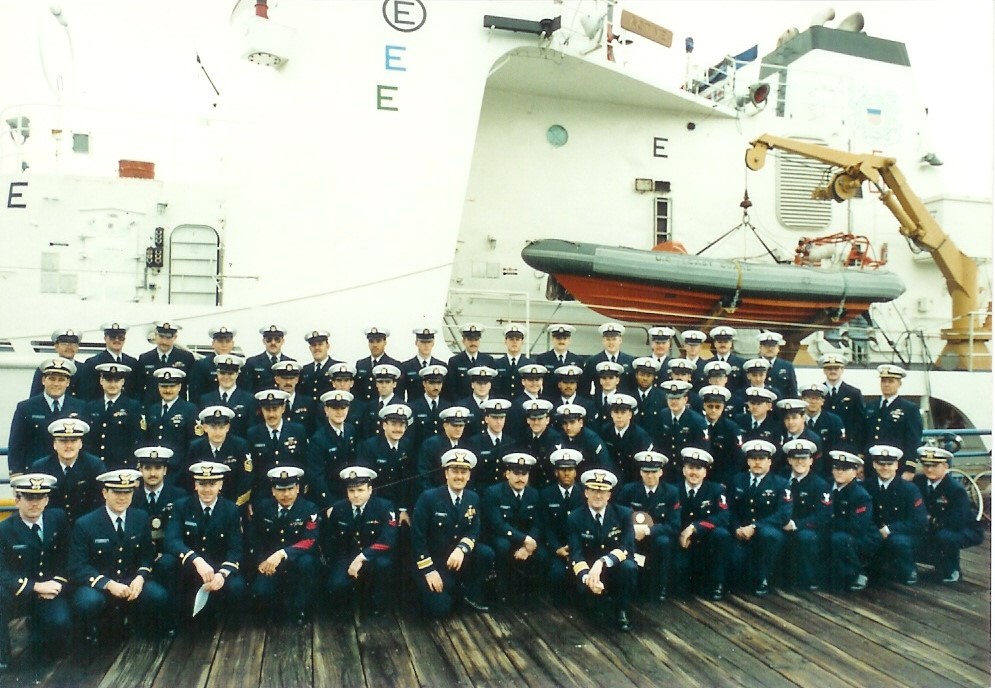
    CGC Active – CGC Active – „Luppert Group Photo“ Scan provided to the USCG Historian’s Office in 2023 courtesy of: CDR Brian J. Tesson Commanding Officer USCGC ACTIVE (WMEC-618)

    The Life of the Enlisted Sailor: Tradition over Regulation

    While officers navigated shifting regulations, the enlisted seaman’s outfit was dictated more by maritime tradition than official rule. Before regulations appeared in 1834, uniformity was largely the result of garments sold in „slop stores“ or shipmates following the same sewing patterns.

    • Deck Work Dress: Sailors wore loose-bottomed trousers that could be easily rolled to the knee for deck work.
    • The Black Neckerchief: A black silk neckerchief was worn as a sweat cloth. Tradition suggests the color was chosen in memory of British Admiral Horatio B. Nelson.
    • „Jack Tar“: In the days of sail, sailors wore their long hair in pigtails and „tarred“ them to prevent tangling in the rigging; this practice led to the nickname „Jack Tar“.
    • Functional Design: The wide, detachable collar on the jumper and the short jacket were designed specifically to prevent tar stains and allow freedom of movement while mounting ratlines or manning footropes.

    Predecessor Agencies: The Lighthouse and Life-Saving Services

    The modern Coast Guard uniform is a tapestry woven from the distinct traditions of agencies that merged into the service over time.

    The Lighthouse Service (Merged 1939)

    Originally formed in 1789, the Lighthouse Establishment featured uniforms as unique as the stations they maintained.

    • „Keystone Cops“ Style: Depot watchmen wore high police-style helmets (black for winter, tan for summer) and single-breasted coats that were often compared to the „Keystone Cops“ of the era.
    • Lighthouse Ornaments: Their buttons and silver cap ornaments featured a lighthouse design, and longevity was shown through gold stars and bars on the lower sleeve.
    na – Lighthouse tender crew; date unknown

    The Life-Saving Service (Merged 1915)

    The Life-Saving Service, organized in 1878, did not authorize uniforms until 1889, a move initially protested because personnel had to purchase them out of their own salaries.

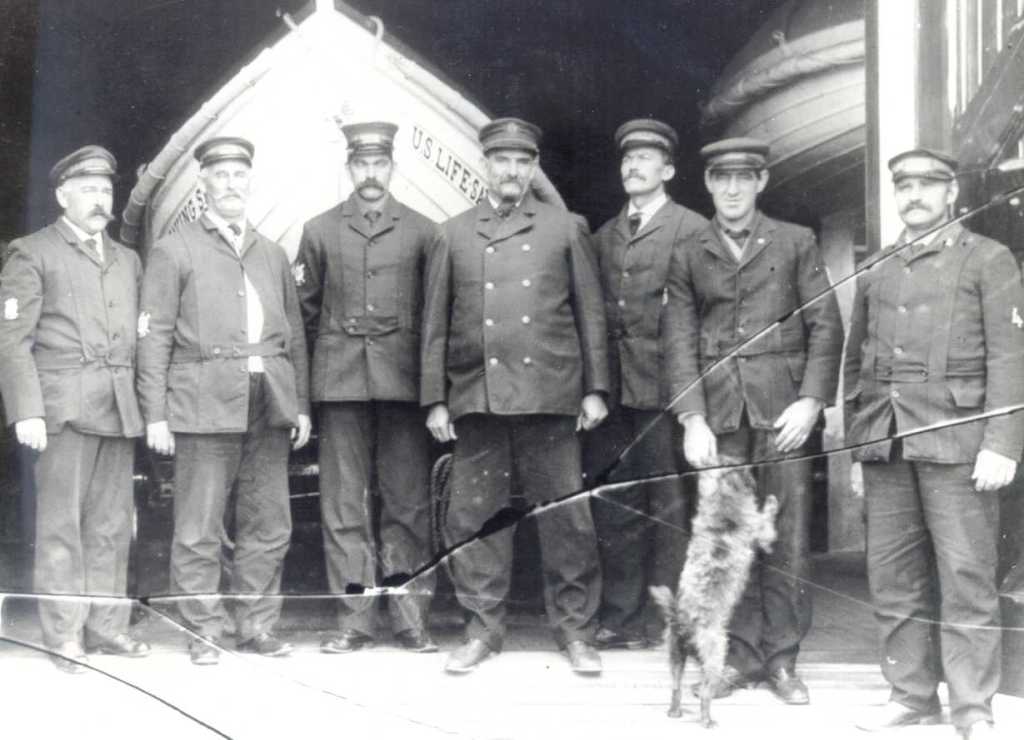
    • The Surfman’s Silhouette: Each station was led by a „keeper“ in a double-breasted coat, while the „surfmen“ wore single-breasted coats with distinctive two-inch-wide pleats running from the shoulders down the front and back, secured by a sewn-in belt.
    • Service Emblems: Their insignia featured a life buoy crossed by an oar and a boat hook.
    na – US Life Saving Service, Unidentified keeper & crew, no date, standard uniform

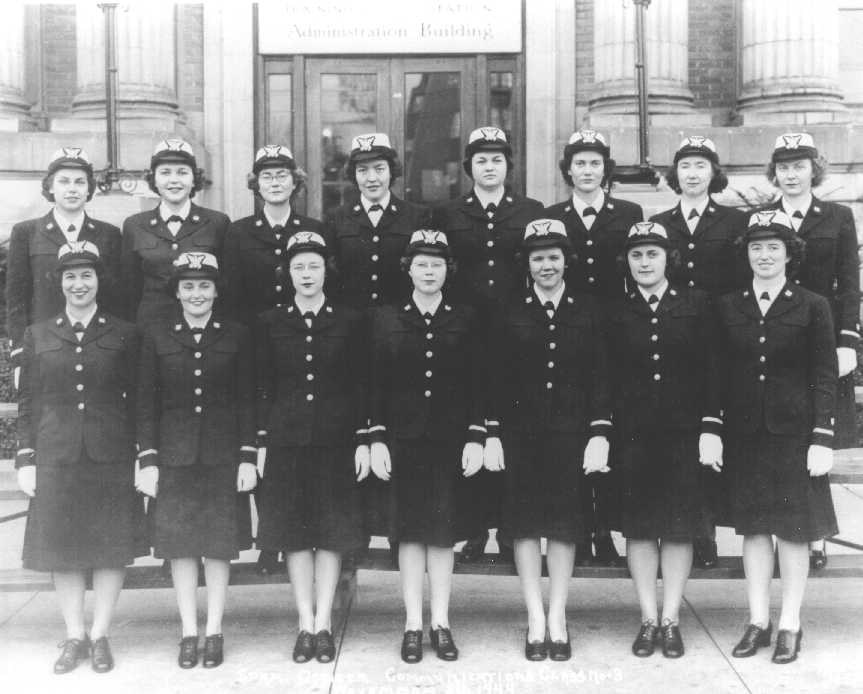
    The SPARS: Women in the Coast Guard (WWII)

    World War II saw the creation of the Women’s Reserve, known as the SPARS.

    • Navy Influence: Their uniforms were designed similarly to the Navy’s female branch (the WAVES).
    • Distinctive Emblems: They were distinguished by Coast Guard emblems worn on the jacket lapels—specifically crossed anchors placed under the Coast Guard emblem.
    na – SPARs Service dress blue WWII

    Conclusion: A Common Thread of Service

    The diversity of the Coast Guard uniform throughout history—from the ornate yellow braids of the 1830s to the „unloved“ gray and the modern „Bender Blue“—reflects the service’s evolution. While its appearance has shifted between mirroring the Navy and asserting a unique identity, a common thread remains. Each iteration of the uniform has been worn by men and women dedicated to providing safety and security on America’s waters.

    Source: https://media.defense.gov/2017/Jun/26/2001768954/-1/-1/0/UNIFORMSCANNEY.PDF (24.04.2026).